Maryland Gov. Moore's $71 billion budget eliminates the deficit, but could shift financial burden to local jurisdictions
Published in News & Features
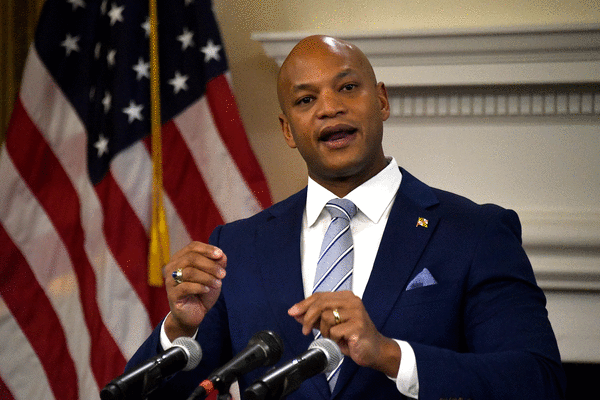
BALTIMORE — Gov. Wes Moore released a $70.8 billion budget proposal on Wednesday for fiscal year 2027 that makes nearly $1.8 billion in program cuts and fund transfers to eliminate a projected $1.4 billion shortfall, in part by reducing cost-sharing with local governments.
The Maryland governor told reporters that the plan, which represents a 5.2% increase from $67.3 billion in FY2026, will lower costs for Marylanders and enhance the state’s economic competitiveness by giving businesses $100 million in tax cuts.
Moore said that the proposal will maintain an 8% rainy day fund, unchanged from fiscal year 2026, and a minimum cash balance of $100 million. The budget also includes a record $124 million allocated to public safety efforts, a $2 million increase from last year — an announcement he made earlier this month. The budget also expands investment in housing supply to $352 million.
Some of the cuts in Moore’s budget include:
— $322 million from the capital budget;
— $292 million from the Strategic Energy Investment Fund;
— $187 million from the fiscal responsibility fund;
— $150 million from the local income tax reserve;
— $145 million from the Rainy Day Fund.
Spending cut by Moore’s budget will be placed into the general fund, acting Budget and Management Secretary Jake Weissmann said Wednesday.
Weissmann said spending in Maryland’s budget will grow by 0.8% in fiscal year 2027. Weissmann added that $322 million of the capital budget, for example, which typically plans for long-term investments like infrastructure, will be cut and used for “general fund relief.” These cuts cover “a wide range” of “future projects” that the state will no longer finance, Weissmann added.
Maryland economists raised alarms that Moore’s budget cuts and fund transfers could increase the burden on local municipalities, forcing them to raise taxes, while Moore avoids it at the state level, avoiding the inevitable blowback during 2026 election year.
“Counties are going to be facing some additional expenses they perhaps were not planning for in FY27, so their recourse: Either they find additional money by cutting their own expenses, or they raise taxes,” Darius Irani, chief economist at the Regional Economic Studies Institute (RESI) at Towson University, told The Baltimore Sun.
“Now I do know that in some cases, some of the counties are already at the maximum level that they can raise their income taxes, so they may be challenged. It’s going to be interesting how they thread this needle of getting additional funds to support services that prior were being supported by the state.”
Kali Schumitz, vice president of external relations at the Maryland Center on Economic Policy, said that the situation is more nuanced and that different jurisdictions, especially those poorer than others, will experience cost-sharing with Maryland differently.
“Some will see an increase in state funding, some might see less state funding,” she told The Sun.
The budget proposal is a result of Maryland being “forced to do more with less,” thanks to President Donald Trump’s administration, Moore said, highlighting the loss of 25,000 federal jobs in the state. The Sun asked Moore how much state spending accounted for the $1.4 billion deficit — which Moore and Weissmann repeatedly said could be attributed to Trump’s policies that have negatively affected Maryland — and how his budget would address state spending.
“Maryland’s spending did not cause a single dollar of federal support for federal disaster relief that usually goes to states regardless of their political voting records [to be taken away]. Now, not a single state that voted for Donald Trump has gotten a dollar of federal disaster relief,” Moore said. “We’re going to control the things that we can control. I can’t control the erratic behavior from the Trump-Vance administration. What I can control is making sure that we can be smart and disciplined in our state, that in our state we are going to say we have to spend wisely and demand more from every single dollar that we’re going to invest.”
Liz Huston, a spokesperson for the White House, pushed back and called Moore and Maryland Democrats “reckless stewards of taxpayer dollars.”
“Maryland’s deficit is the direct result of their wasteful spending and failed priorities,” Huston wrote in a statement to The Sun. “Instead of passing blame, Governor Moore should take some accountability and turn his state around.”
How cuts will look
Moore’s budget proposal will also siphon $150 million from the local income tax reserve into the general fund. Maryland Comptroller Brooke Lierman on Tuesday urged lawmakers to avoid passing significant new tax measures because of an August rollout of a new tax processing system, warning that her office has “almost no capacity” to make requested changes.
A Moore administration official argued Moore’s budget “is not taking money from the local governments” because an audit discovered the state had put aside “too much money for local government” in the reserve than it needed.
“The comptroller’s office collects income tax revenues from everyone, for both the state and for the local governments. You only pay your income tax to the comptroller [and] she and her staff have to figure out how much of your income tax goes to whatever jurisdiction you live in,” this official said. “Income tax comes in at different times during the year, so there are multiple distributions. Money gets sort of put in that account, and then the comptroller’s staff figures out how much that belongs to the state, how much of that belongs to the local government.”
Lierman’s office did not respond to a request for comment by the time this story was published.
Another hallmark of Moore’s budget is that it’ll result in a net addition of 250 jobs across Maryland agencies, — a move that stands in stark contrast to the hiring freeze Moore instituted last June to claw back on the state’s personnel expenses.
When asked whether these job additions go against Moore’s freeze, another Moore administration official said “secretaries in the departments determine the definition of what’s exempted from the hiring freeze” and that departments are ultimately still “required to live within their budgets.”
Maryland Republicans’ perspective
Maryland House Republicans said that Moore’s proposal “is largely based on accounting tricks” that led the state to “yearly multi-billion-dollar deficits.”
Senate Minority Leader Steve Hershey cautioned that Moore’s budget not raising taxes and fees distracts from the burden it could place on local municipalities, where Hershey believes higher local taxes are likely to come. Hershey also warned that the General Assembly could very well hike taxes even if Moore has pledged not to do so. The budget “relies on moving and raiding funds to support ongoing spending. Now that the budget is in the hands of the General Assembly, we’ll see how it ultimately takes shape…” Hershey said in a statement.
House Minority Whip Jesse Pippy argued that Moore “still dumping money into pet projects as if taxpayers have money to burn,” referencing Blueprint for Maryland’s Future, the state’s landmark public school reform plan, the metro system, and “failed green energy schemes.”
“Marylanders cannot take much more,” Pippy said.
________
©2026 The Baltimore Sun. Visit at baltimoresun.com. Distributed by Tribune Content Agency, LLC.




Comments