Colorado confirms it won't release more wolves this winter after feds stopped deal with Canada
Published in News & Features
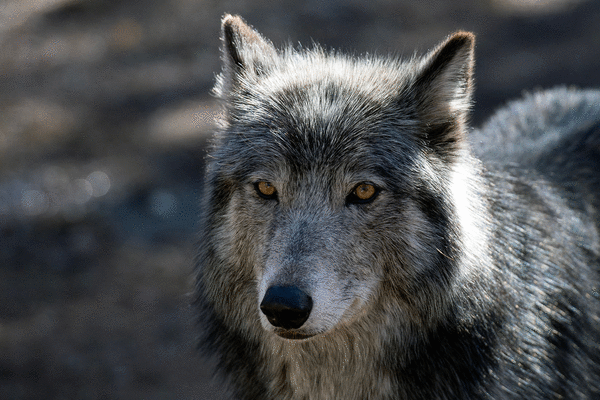
DENVER — Colorado will not release more wolves this winter to supplement its reintroduction program after federal officials stopped the planned relocation of wolves from Canada.
Colorado Parks and Wildlife officials confirmed Wednesday that they have no plans to release more wolves this season and are instead exploring options for next winter. They had been working toward an annual round of releases targeted for early 2026, around the same time of year as two earlier release cycles.
“During this intermediate time, CPW will continue to meet with producers and other stakeholders, including U.S. Fish and Wildlife Service, to explore how to maximize the restoration effort and achieve our plan of establishing a self-sustaining gray wolf population in Colorado,” CPW acting Director Laura Clellan said in a news release.
CPW officials had struck a deal with Canada last year to capture up to 15 wolves from British Columbia and release them in Colorado this winter. The state captured and released 15 wolves from the Canadian province the prior winter.
But officials with the U.S. Fish and Wildlife Service under the Trump administration said in October that bringing wolves from Canada would violate a legal agreement between CPW and the federal agency. The threat was an about-face for the federal agency, which approved the use of Canadian wolves under the Biden administration.
It’s unclear how the lack of a wolf release this year could impact the state’s goal of creating a self-sustaining wolf population.
CPW announced that there would be no releases a day after announcing that another reintroduced wolf had died. The female wolf was one of the 15 captured in Canada in 2025 and was found dead Friday in northwest Colorado.
Fish and Wildlife biologists will investigate the cause of death, CPW said Tuesday.
Eleven of the 25 wolves released as part of the reintroduction effort have since died.
“When populations are small, the contributions of each individual is especially significant,” CPW Wolf Program Manager Eric Odell said in the news release announcing no releases this winter. “It is not possible to predict the impact of foregoing a third year of translocations without knowing what may occur in the coming year. If mortality remains high, as observed in 2025, the risk of failing to achieve a self-sustaining wolf population in Colorado increases, potentially requiring additional resources to address.”
The number of wolves in Colorado is unknown as biologists attempt to count the number of surviving pups born in the past year. Nineteen collared wolves currently roam Colorado, and at least 10 pups were born this summer in the state’s four known packs.
CPW has struggled to find states or tribes in the U.S. willing to provide the wild canines for the state’s voter-mandated reintroduction program.
State wildlife officials released the first batch of wolves — 10 adults captured in Oregon — in December 2023, three years after voters approved the reintroduction ballot measure. CPW officials had first asked Idaho, Montana and Wyoming for wolves but were rejected.
The Confederated Tribes of the Colville Reservation in Washington state backed out of a 2024 agreement to supply the canines out after speaking with the Southern Ute Indian Tribe, which has reservation land in Colorado.
CPW then turned to Canada, where it captured 15 wolves in January 2025 and rereleased them in Colorado.
When federal officials this fall signaled opposition to the use of Canadian wolves, CPW turned to the state of Washington.
While that state’s wildlife agency previously signaled a willingness to participate in Colorado’s reintroduction, its wildlife commission in November voted against allowing the relocation of its wolves. The commission cited concerns about wolf mortalities in Colorado, about anti-wolf sentiment in some ranching communities here and about Washington’s own declining wolf populations.
_____
©2026 MediaNews Group, Inc. Visit at denverpost.com. Distributed by Tribune Content Agency, LLC.






Comments