WA turns to goats for affordable, sustainable landscaping
Published in Business News
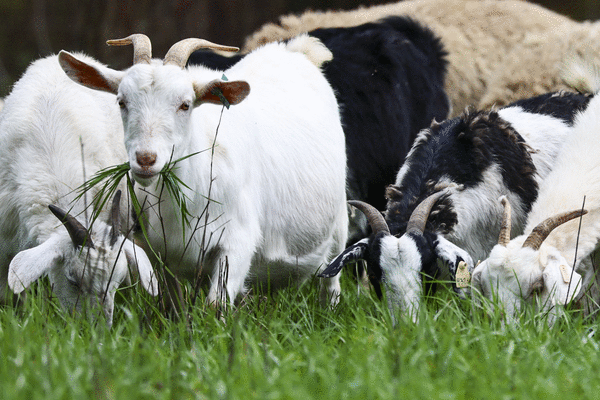
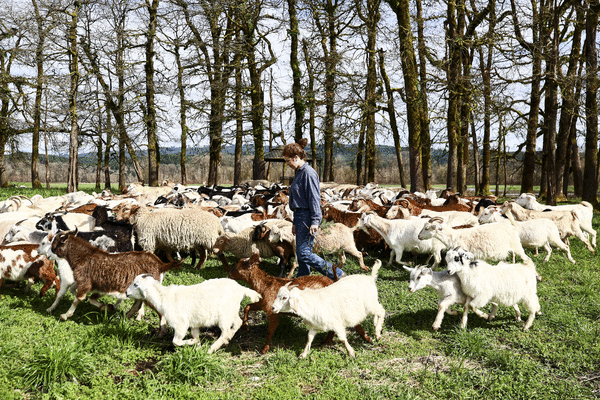


Last summer, Juris Sarins hosted a bevy of first-time guests for two weeks on his property in Klickitat County's Snowden, feeding them fresh vegetarian meals. His visitors: More than 100 goats, chomping through several acres of thick vegetation.
They eat everything," he said.
Instead of a crew of landscapers, Sarins enlisted the help of a herd managed by Will Lyons of Northwest Grazing to remove flora for aesthetics and wildfire mitigation. His property sits on a steep slope, with a canyon running north.
"The concern is that, if a fire starts in that canyon, it would carry up the canyon, and it would get close to the house and endanger the house," he said. "(The goats) did take a lot of the vegetation down that we were concerned with, so, you know, it's pretty useful."
As Washington shakes off the Big Dark and celebrates the spring equinox Friday, homeowners are faced with looming seasonal chores like lawn care, which can range between hundreds and thousands of dollars for cleanups by professionals in the Seattle area.
Motivated by affordability and sustainability rather than fast turnaround times, some have found an alternative in goatscaping, also known as targeted grazing or contract grazing.
While ruminant animals fill their bellies with errant shrubbery, property owners reap the benefits of an all-natural, entertaining approach to landscaping. A modest group of small businesses — full-time operators and side gigs alike — are opening their books for the approaching busy season as demand climbs.
"Business is going really well," said Olivia Raine, of Raine Grazing Services in Grays Harbor County. A goat bleated in the background of the phone call. "There's just not that many people that do this."
Full-time goat grazers
In Issaquah, some homeowners have used goat grazing for almost two decades because it's an economical and "green" landscaping option.
"It's a tradition here now in our community," Sarah Hoey, executive director of the Issaquah Highlands Community Association, said in a phone interview.
The neighborhood, made up of more than 4,700 homes, has used goats for grazing since 2009. The practice is a safe way to tackle the maintenance of 12 acres of steep slope classified as open space, Hoey said.
It costs about $30,000 annually, which is cheaper than manual labor, Hoey said. The figure is rolled into the association's general operating budget as part of the landscaping program.
The goats are typically ready for duty after Fourth of July (to avoid rattling encounters with fireworks). The association's team ensures the area is absent of trash, animal feces and poisonous plant varieties before the animals arrive.
Neighbors often gather to watch them work.
There is a catch, however: The association is liable for the use of goats, due to the proximity of the homeowners' properties. Temporary electric livestock fencing is used to contain them in the right areas.
In 2019, the community saw the animals' destructive sides during what Hoey called "the great goat escape." Around 200 goats broke free of their constraints and high-tailed it to front yards for hors d'oeuvres before getting wrangled into a dog park.
Another challenge is the availability of herders, Hoey said, after their former grazer approached retirement. "There's less and less of them now."
That's where Raine stepped in to fill the gap.
She has run Raine Grazing Services full-time since 2023. She moved her operations across state lines after spending a few years in California's Central Valley.
There, Raine used sheep to graze the grasslands. But in Western Washington's temperate rainforest, she knew she'd need goats — ruminant animals that don't shy away from eating tall plants.
There's a lot of work to go around, she said. Raine only takes projects that are over two acres in size, and about 75% are commercial, such as golf courses and college campuses.
After the kids are born at the farm between now and April, she'll have more than 200 animals to serve large worksites in King and Thurston counties over the summer.
Raine manages the herd with a team of canines: three herding dogs and a guardian dog that protects them from coyotes and eagles.
She considers herself part of the state's second generation of goat grazers.
Raine, who studied environmental sciences at The Evergreen State College in Olympia, decided against conventional agriculture jobs like ranching to ensure her financial stability. Then, she learned about the targeted grazing industry.
In her opinion, it serves as a form of ecological stewardship — and human enjoyment.
"I wanted to be in something that felt proactive and productive," Raine said.
Goatscaping as a side gig
Several Seattle-area residents have turned to goat grazing as a side hustle.
Eric Billings has multiple streams of income, but he focuses on his business, Evergreen Goat Rental, during the summer.
"You don't get too many calls in the dark January," he said in a phone interview.
In the dead of winter, his goats live on a farm, chomping hay. But it's a different story between May and September, when the herd of around 50 is clearing greenery across Snohomish and King counties.
Billings founded his business in 2023, and it's grown since.
He's established a protocol on the job site: dropping the goats off, giving them water and setting up a fence before they get to work.
The animals strip graze the vegetation "kind of like when we eat a steak: We eat the meat and leave the bones," Billings said. He clears what's left over with his cutter.
Typically, a 1,000-square-foot backyard only takes a day or two. The project timeline for larger commercial properties varies based on size and volume.
"It's probably on par or cheaper than your general landscaping," Billings said.
Meanwhile, Dean North balances his side business, Goats Plus, with a full-time job at a municipality. His goats serve the 50-mile radius around Tacoma.
He was first introduced to goatscaping around a decade ago when he purchased a piece of property that was heavily overgrown. After attempting to hack away the vegetation with a machete, North bought goats from a co-worker to get the job done.
His herd has since expanded to 33 goats. He established the business to help pay for their feed in the winter.
North's busy season kicks off now through late October. Hospitals, homeowner associations and property owners have all approached him for his services.
Goats Plus charges $200 per week, with a one-time $50 transportation charge, for five goats, according to its website. For 10 goats, it jumps to $350.
"Honestly, a lot of people just love goats," North said in a phone interview. "There's a lot of jobs where it's really not as efficient as somebody doing it, but they just want to sit and watch goats."
He also rents out the goats for event appearances — around $100 per hour, plus a $50 transportation fee — at birthday parties, concerts and Christmas Nativity scenes at churches.
It's proving to be a profitable venture. Goats Plus, which also removes trees, sells firewood and rents a dump trailer, made over $100,000 last year in revenue.
"It's just one of those things: I've got 'em, and they don't. They ask for 'em, and there you go," North said.
'It's not a new method'
State officials are backing landowners who embrace goatscaping to limit the spread of future wildfires.
Alison Martin, a service forestry planner at the Washington State Department of Natural Resources, implements a financial assistance cost share program for small private forest landowners in Eastern Washington.
The landowners who work with her agency have increasingly chosen goats for grazing over the past two years, Martin said.
The ruminant animals eat vegetation and debris, which typically fuel wildfires. Less fuel means a less severe fire.
"It's not a new method," Martin said in a phone interview. "Historically, goats have been used for fuels mitigation."
She highlighted other benefits. Goats can do less property damage than heavy machinery, and they're effective at controlling invasive species without spraying herbicides.
If the costs are split between a few landowners, the move can keep prices lower — and it means goats are munching their way through a larger area, which promotes fire mitigation.
As winter turns to spring and greenery unfurls, "the best time to graze is actually right now," Martin said. "Who wouldn't want adorable goats on their property to help them with their fuels mitigation work?
©2026 The Seattle Times. Visit seattletimes.com. Distributed by Tribune Content Agency, LLC.










Comments