Critics call it the 'show your papers' bill. Republicans say it will restore trust in elections
Published in Political News
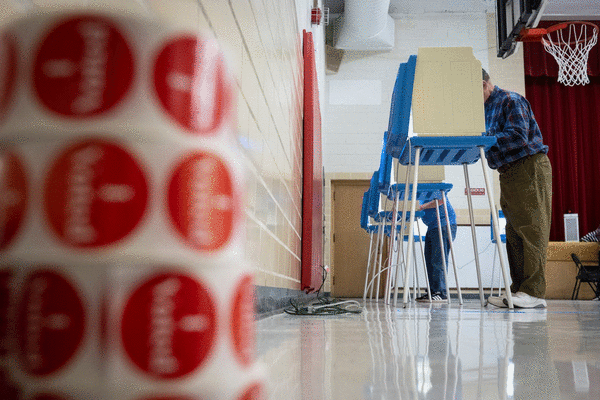
President Donald Trump is pushing for the passage of a law that would require voter ID and make a suite of other changes to the nation’s voting systems that advocates have warned would disenfranchise millions of Americans.
The Safeguard American Voter Eligibility, or SAVE America Act, passed the U.S. House in February in an effort to require proof of citizenship and a photo ID for this year’s midterm elections.
Lawmakers joined Trump in recent weeks to build public support for the measure while arguing the bill would restore trust and help safeguard local and federal elections.
“We need election integrity now more than ever,” Rep. Tom Emmer said at a news conference last month. The Minnesota Republican points to public polling that shows support for requiring voter ID.
Critics claim the law would disenfranchise millions of Americans because its requirements could create detrimental obstacles to the voting process.
“It would introduce unprecedented chaos into our election system, not only in Minnesota but across the country,” Minnesota Secretary of State Steve Simon said in 2025. “We’re going to count on the U.S. Senate to stall or defeat this bill.”
The House approved similar legislation in 2024 and 2025, but it never received Senate approval.
People would be required to bring documentary proof of U.S. citizenship when registering to vote in federal elections. States would also establish an alternative process for people to submit evidence of their citizenship, and would be required to remove noncitizens from their lists of eligible voters.
Only a handful of states provide driver’s licenses that offer proof of citizenship, according to the National Conference of State Legislatures. In Minnesota, residents would need an Enhanced ID, which is only available to U.S. citizens, to register to vote. A Real ID would not be sufficient for registration.
Millions of Americans also do not have a birth certificate.
The bill would require anyone applying for and submitting absentee and mail ballots to provide a photocopy of their identification during both steps. Most states do not have that requirement.
Cassondra Knudson, spokesperson for the Office of the Minnesota Secretary of State, said the bill would likely end online voter registration.
The bill also does not provide additional funding for new responsibilities it creates for states to run the elections, nor does it include a phase-in period. The law would take effect immediately if passed by the Senate.
Former Vice President Mike Pence and many Republicans have publicly supported passing the bill into law, explaining that the measure would restore public confidence in elections.
“Minnesota families deserve secure elections, where every vote counts — for citizens only. Thank you, President Trump for your support of keeping our elections safe and secure,” Republican Rep. Pete Stauber posted to social media last month.
There’s little data to support claims that noncitizen voting is widespread. Data from states reviewed in 2024 suggests that voting by noncitizens is rare, and one study from the University of St. Thomas found three Minnesota convictions for unlawful voting or registration between 2015 and 2025. All three people were lawful permanent residents.
Federal law already requires voters in national elections be U.S. citizens.
Trump vowed retribution for lawmakers who vote against the measure, urging voters to support what he calls the “most important and consequential” piece of legislation in congressional history.
“Only sick, demented, or deranged people in the House or Senate could vote against THE SAVE AMERICA ACT. If they do, each one of these points, separately, will be used against the user in his/her political campaign for office — A guaranteed loss!” Trump’s social media post read.
Opponents say the SAVE America Act, also referred to as the “show your papers bill,” would create obstacles to voting that could prevent millions from getting to the polls.
Minnesota Democratic Sen. Amy Klobuchar said the bill was designed to make it more difficult for people to vote and help Republicans in upcoming elections, pointing to recent comments from Trump that the bill would “guarantee the midterms.”
“That is what is going on here,” she said at a virtual news briefing on Thursday. “We believe we should make it easier to vote. This bill doesn’t do that.”
Simon said this week that the bill would wreak havoc on state and local election officials as they prepare for the election this fall. While other large federal election laws passed in recent decades took effect over months and years, the new bill would take effect immediately.
That means elections officials would suddenly be required to assess the legitimacy of birth certificates and other documents the bill would require voters to present to prove their citizenship, Simon said. That massive administrative task would be “a particularly hard burden for those on the front lines,” he said.
According to Simon’s office, only 17% of Minnesotans have an ID that proves citizenship, such as an Enhanced ID, and 55% have a passport. Applications for both must be done in person, come with fees and take weeks to process.
Simon likened the specter of the SAVE America Act becoming law and other federal threats to upend elections — including the president’s push to “nationalize” and “take over” elections — to more routine election scenarios his office prepares for, like power outages, bad weather and other disruptions.
“It’s a sad thing that in 2026 we have to treat this like a bomb threat,” he said. “It’s not a prediction, but it is a precaution that we have to take.”
House lawmakers approved the bill this year along mostly party-line votes at 218-213. The bill is expected to face resistance in the Senate, where Republicans have majority control, though some have suggested a marathon filibuster to push it through.
_____
©2026 The Minnesota Star Tribune. Visit startribune.com. Distributed by Tribune Content Agency, LLC







































Comments