California lawmakers push forward bill to curb mental health diversion for public safety
Published in Health & Fitness
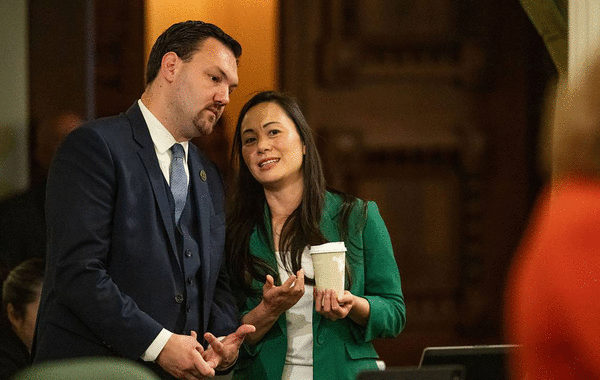
SACRAMENTO, Calif. — Prosecuting attorneys from across California, including from Sacramento County, cheered a state Senate committee’s passage of a bill Tuesday they say will prevent the release of violent criminals through the state’s mental health court diversion program.
The bill, carried by Assembly member Stephanie Nguyen, D-Elk Grove, creates more leeway for judges to rule that a defendant is not eligible for the diversion program, in which criminal defendants are given the chance to enroll in behavioral health and substance abuse programming, under court supervision, instead of being incarcerated. The California Legislature first enacted mental health diversion programs in 2018.
Supporters of mental health diversion say the program had considerable statistical success in California. People who pass through them are 30% less likely to commit a new crime than people who have served a prison sentence, according to the California Public Defenders’ Association, which is among a litany of criminal justice and mental health organizations opposing Nguyen’s measure. Those positive results for defendants are paired with major savings to the state through reduced incarceration costs, as well as a reduction in the number of families broken up by prison sentences, bill opponents say.
But bill proponents, including prosecutors and law enforcement and the relatives of people killed by someone released through mental health diversions, point to a number of cases where people released under mental health diversion programs have gone on to commit acts of horrific violence while enrolled in treatment programs and out on the streets.
Placer County District Attorney Morgan Gire told lawmakers that such cases are stacking up around the state.
“These are not anomalies, these are not one-offs, these are happening with regularity because of the current structure of the mental health diversion scheme,” he said.
Among the proponents present in the Legislature on Tuesday was Shelley Catanyag, whose husband was stabbed and killed while conducting his duties as a Sacramento County Health Inspector. The man who killed him was a stranger suffering from schizophrenia who was released from custody under the mental health diversion program, Catanyag said.
“I have a daughter, she was about to turn six years old when her dad did not come home,” she said, speaking at a news conference after the committee heard the bill.
“I very much see a need for this bill,” Catanyaq said, “and I hope that it can maybe prevent this from happening to other families.”
Nguyen said the law as written has sidelined judges to the point where they’re forced to put people back out on the streets even when they know they could be violent.
“We are not eliminating the program,” she said Tuesday. “We are just putting guardrails around it.”
But opponents of the measure say it will tie courts’ hands in the other direction, by imposing an unreasonable standard where a judge would have to be entirely certain there is no threat to public safety before releasing someone into community treatment.
Neither prison nor probation, the other two options available to judges, would provide a greater guarantee of public safety, given that the defendant would end up back on the streets barring a life sentence, the public defenders association wrote. (Existing law already bars mental health diversions for cases where the crime might warrant a life in prison.)
“The failure to understand that mental health diversion is the option with the best chances of success for the community and the individual is exactly what is wrong with (the bill),” the public defender’s association wrote in its opposition to the measure.
Nguyen’s measure has considerable momentum and appears likely to reach Gov. Gavin Newsom’s desk. The Senate Public Safety Committee voted 5-0 to advance the bill, which now goes to the Senate Appropriations Committee. The California Assembly voted 56-7 in favor of the bill last May.
The Elk Grove Assembly member has had encouraging conversations with Newsom’s staff about the measure, she said. Newsom has been a support of mental health diversion programs in California’s courts, which have grown during his tenure.
_____
©2026 The Sacramento Bee. Visit sacbee.com. Distributed by Tribune Content Agency, LLC.








Comments