Was 1976 the best year ever for great albums? The fifth best? Or neither?
Published in Entertainment News
SAN DIEGO — Welcome to this year’s exciting edition of “Watching a Red-Faced Music Critic Paint Himself Into a Corner!”
The critic in question is, well, me. The corner I have painted myself into is the result of the four stories I have written over the past four years declaring — in order — that 1972 was the best year ever for great albums, 1973 the second best, 1974 the third, and 1975 the fourth.
With such seemingly diminishing returns, would anyone in their right mind want to read — a decade from now — an article with the headline: “Was 1986 the 15th best year ever for great albums?” And what kind of fool would write such an article? Not even a fool such as I.
That said, while 1976 overall yielded fewer absolutely essential albums — at least in my highly subjective opinion — the year did not lack for great albums.
The list of my 1976 favorites includes standout recordings by everyone from Bob Dylan (“Desire”), Weather Report (“Black Market”), David Bowie (“Station to Station)” and Earth, Wind & Fire (“Spirit”) to Rod Stewart (“A Night on the Town”), Jackson Browne (“The Pretender”), Parliament (“The Clones of Dr. Funkenstein”) and Waylon Jennings & Willie Nelson (“Wanted! The Outlaws”).
But that’s only a partial tally of some of my favorite releases from 1976, which is the same year I began writing freelance album reviews for the San Diego Reader.
It was the year that presaged the punk-rock explosion of 1977, which was also the year I enrolled at SDSU and became the drummer in my first San Diego band, the jazz-rocking Focal Point. But that’s a story for another day.
Other standout 1976 albums that I still savor came from such varied artists as Ry Cooder (“Chicken Skin Music”), the Patti Smith Group (“Radio Ethiopia”), Boz Scaggs (“Silk Degrees”), Chick Corea (“My Spanish Heart”), Hound Dog Taylor and the House Rockers (“Beware of the Dog”), the Dwight Twilley Band (“Sincerely”), Tangerine Dream (“Stratosphere”), Graham Parker & the Rumour (“Howling Wind” and “Heat Treatment”), Kevin Coyne (“Heartburn” and “In Living Black and White”), Jean Michel Jarre (“Oxygene”), Dr. Feelgood (“Stupidity”) and former Valley Center singer-songwriter J.J. Cale (“Troubadour”).
Equally as appealing to me are the 1976 albums by artists from around the world. I nabbed many of them at bargain rates at downtown’s Arcade Music, a vinyl goldmine that opened in 1958, closed 30 or so years later, and once counted Frank Zappa and Folk Arts Rare Records honcho Lou Curtiss among its devoted clientele.
The 1976 albums I acquired at Arcade — some that year, some later on — were by innovators from Germany (Eberhard Weber’s “The Following Morning”), Brazil (Jorge Ben’s “Africa Brasil”), Nigeria (Fela Kuti & Africa 70’s “Zombie”), Puerto Rico (Hector Lavoe’s “De Ti Depende”), Jamaica (The Gladiators’ “Trenchtown Mix Up,” The Heptones’ “Night Food,” U’Roy’s “Natty Rebel” and Max Romeo & The Upsetters’ “War ina Babylon”), and Ireland (The Chieftains’ “Chieftains 6: Bonaparte’s Retreat” and The Bothy Band’s memorably titled “Old Hag You Have Killed Me”).
Just as memorably, 1976 also saw the release of an impressive number of superior debut albums that would surely merit a Top 10 list of their own. I can cite at least a dozen off the top of my head.
I’m thinking specifically of the maiden solo efforts by Pat Metheny (“Bright Size Life”), Peter Tosh (“Legalize It”), Southside Johnny & the Asbury Jukes (“I Don’t Want To Go Home”), Randy Crawford (“Everything Must Change”) and Bootsy’s Rubber Band (“Stretchin’ Out in Bootsy’s Rubber Band”). I’m also thinking of the self-titled debut albums by Jaco Pastorius, Ramones, Kate & Anna McGarrigle, The Wild Tchoupitoulas, Bandit, The Modern Lovers, Third World, Tom Petty & The Heartbreakers, and — led by San Diego’s Jack Tempchin — the Funky Kings (whose 1976 concert at SDSU’s Backdoor club, with Mike Finnigan sitting in on organ, was exceptional).
There were also potent 1976 live albums by Bob Seger & the Silver Bullet Band (“Live Bullet”), Herbie Hancock (“V.S.O.P.”), Clifton Chenier & His Red Hot Louisiana Band (“Cajun Swamp Music Live”), Wings (“Wings Over America”), Joan Baez (“From Every Stage”), Tower of Power (“Live and in Living Color”), John Martyn (“Live at Leeds”), Archie Shepp (“Montreux One” and “Montreux Two”), George Benson (“In Concert-Carnegie Hall”), David Murray (“Flowers for Albert”), Henry Cow (“Concerts”) Shakti (“Shakti with John McLaughlin”), Commander Cody & His Lost Planet Airmen (“We’ve Got A Live One Here!”) and San Diego sax great Charles McPherson (“Live in Tokyo”).
Missing from this list are live albums that were recorded in 1976 but did not come out until subsequent years. As an attendee at the 1976 edition of the famed Montreux Jazz Festival in Switzerland, I was fortunate to attend a number of concerts that were later commemorated on live albums.
They include releases by Nina Simone (“The Montreux Years”), Luther Allison (“Montreux 1976”), Sun Ra & His Intergalactic Cosmo Arkestra (“Live at Montreux”) and the oh-so-funky band Stuff (“Live at Montreux 1976”). Like many of my favorite live performances from decades before and since, these four are mesmerizing — albeit for very different reasons.
I didn’t attend nearly as many 1976 concerts as I would have liked to in San Diego, where I had moved in late 1975 from Frankfurt, Germany. But most of the ones I did go to here were memorable. They include: a triple-bill of the Count Basie Orchestra, Big Joe Turner and Joe Pass at San Diego Civic Theatre; jazz piano giants Keith Jarrett and Bill Evans at UC San Diego; Jeff Beck and The Kinks at Golden Hall; and Ian Matthews’ Roadside Attraction and the Bob Weir-led Kingfish at the Backdoor.
Happily, I saw a dizzying array of more than 50 outstanding artists at the Montreux Jazz Festival in 1976. The 17-day lineup included everyone from Al Jarreau, Leonard Cohen, the Crusaders, Cecil Taylor, Billy Cobham and the Mighty Clouds of Joy to Weather Report, Art Blakey, Odetta, the Newport Jazz Festival All Stars and the John McLaughlin-led Shakti.
As soon as I returned to San Diego that fall, I made a beeline for Arcade and the Tower Records on Sports Arena Boulevard to seek out albums by Jamaican pianist Monty Alexander, French violinist Didier Lockwood and other then-new-to-me artists I had heard that summer for the first time in Montreux.
For some readers, the 1976 albums that didn’t make my list of favorites will surely evoke surprise or perhaps even dismay. But selecting one’s favorite music is always subjective. So is picking our favorite food, movies, sports and almost anything else where our individual preferences don’t always align with that of others. And what a dull, bland, stifling world it would be if we all shared the same likes, dislikes, and “mehs.”
So, while several of the bestselling albums of 1976 went on to become some of the bestselling of all time, that doesn’t make them my favorites. True, all the albums I am now about to cite contain classic songs that are forever embedded in my consciousness. But the albums themselves don’t hit the mark for me from start to finish — again, in my subjective opinion — however excellent some of the music they contain.
That is why my list of favorites doesn’t include the 1976 albums by Eagles (“Hotel California”), Aerosmith (“Rocks”), Kiss (“Destroyer”), Electric Light Orchestra (“A New World Record”), Boston (“Boston”), Led Zeppelin (“Presence”), Peter Frampton (“Frampton Comes Alive”), or Queen (“A Night at the Races”). For the record, I have multiple albums by nearly all of these artists and have thoroughly enjoyed my interviews over the years with Frampton and members of the Eagles. Aerosmith, Kiss, Boston, Electric Light Orchestra, Led Zeppelin and Queen.
Without further ado, here in alphabetical order, are my picks for some of the best albums of 1976. Of course, if you ask me tomorrow, I might cite a different batch of albums from the same year, and a different batch a day later.
Joan Armatrading, “Joan Armatrading”
A native of Saint Kitts and Nevis who grew up mostly in Birmingham, England, Joan Armatrading had two promising albums to her credit prior to “Joan Armatrading,” and has since made 18 more. But to my ears, she has never shined as brightly as on this superb, 10-song collection.
Deftly drawing from folk, soul, blues, funk and country, Armatrading sings of love lost, won and desired, heady aspirations and quiet desperation, in a deep, richly moving voice. Her intensely romantic ballad, “Love and Affection” contains one of my all-time favorite opening lines: “I am not in love, but I’m open to persuasion.”
Armatrading’s potent acoustic guitar work has been cited as a key influence by such admirers as Ani DiFranco, while Jerry Donahue’s incisive electric guitar playing and Dave Mattacks’ impeccable drumming elevate “Joan Armatrading” even more. So does the sterling production work of producer Glyn Johns, whose other credits include albums by the Rolling Stones, Eagles, Eric Clapton, Linda Ronstadt and Bob Dylan.
There are also marvelous touches throughout that make me smile each time I hear them, be it B.J. Cole’s finely honed, 15-second-long pedal steel interlude on the album-opening “Down To Zero,” the staggered jazz-funk syncopations that propel “Join The Boys,” or the pitch-perfect calibrations Armatrading and her band bring to the album-closing “Tall In The Saddle,” on which Mattacks’ succession of ingenious drum fills provide a master class on how skillfully crafted percussive punctuations can enhance a song, rather than detract or steal attention.
Jeff Beck, “Wired”
After turning down an invitation to replace Mick Taylor in the Rolling Stones, English guitar great Jeff Beck made the million-selling “Blow By Blow,” his first all-instrumental album. Inspired by trumpeter Miles Davis’ 1971 album, “Jack Johnson” — which featured guitar great and Mahavishnu Orchestra founder John McLaughlin — and by Mahavishnu’s combustible 1973 live album, “Between Nothingness and Eternity,” 1975’s “Blow By Blow” significantly expanded Beck’s audience by combining rock power and blues passion with the sophistication of fusion-jazz.
“Wired” pushed the envelope farther, thanks to the pivotal contributions of former Mahavishnu keyboard and synthesizer wiz Jan Hammer and the propulsive drumming of Narada Michael Walden, who joined the Mahavishnu band shortly after Hammer left. Clearly delighted to be in their company, Beck ups his game accordingly. From the metallic funk of the album-opening “Led Boots” and the blazing “Blue Wind” to the wonderfully twisting “Head For Backstage Pass,” he repeatedly ignites but never goes into guitar overkill. And Beck’s rhapsodic take on the Charles Mingus jazz classic “Goodbye Pork Pie Hat” is a marvel of luminous melodic and harmonic invention.
James Brown, “Get Up Offa That Thing”
The rise of disco in the mid-1970s prompted too many soul-music greats to halfheartedly jump on the bandwagon. The results were mostly negligible, be it Wilson Pickett’s “A Funky Situation,” Aretha Franklin’s “La Diva” or — in 1979 — James Brown’s “The Original Disco Man.” Brown fared much better with his 1976 album, “Get Up Offa That Thang,” a sinewy tour de force in the art of the groove, on which he musically embodies a veteran heavyweight boxing champ who knows exactly when to strike for maximum impact and when to pull back.
Seven songs strong, “Get Up” was the 43rd album of Brown’s groundbreaking career. Apart from “Home Again,” a lithe, jazz-tinged blues number, and the Philly soul-flavored “You Took My Heart,” the focus is on taut, propulsive funk workouts. With an average playing time of more than eight minutes each, “Can’t Take It With You,” “I Refuse To Lose” and “This Feeling” expertly build dynamic tension from start to finish. And when Brown exults “I’m back!” — five times in a row — at the start of “Get Up’s” kinetic title track, no one could doubt him.
Miles Davis, “Pangaea”
Clocking in at more than 90 minutes, “Pangaea” was recorded in Osaka, Japan, on Feb. 1, 1975, at what would prove to be one of the ailing Miles Davis’ final live performances until 1981. Suffering from hip problems and stomach ulcers, the jazz-and-beyond trumpet colossus and legendary musical shape-shifter was approaching such a low ebb that — after a July 1 concert at New York’s Lincoln Center — he did not pick up his horn again until 1980.
But no matter. Then and now, “Pangaea” bristles with searing vigor throughout. Heading a band anchored by powerhouse drummer Al Foster and former Stevie Wonder bassist Michael Henderson, Davis repeatedly pushes the envelope on two pieces, “Zimbabwe” and “Gondwana.” Each lasts more than 40 minutes. Neither is for the faint of heart or ear.
Together with saxophonist/flutist Sonny Fortune, percussionist James Mtume and Jimi Hendrix-inspired guitarists Pete Cosey and Reggie Lucas, Davis, Foster and Henderson lay down a ferocious funk groove on “Zimbabwe.” A take-no-prisoners epic, it boldly sings — and singes — the body electric as Davis plays swirling solos with and without a wah-wah pedal. Slow and sultry at first, “Gondwana” builds to a hard-rocking climax, then shifts into a low-key blues before ending with edgy electronic bleeps and blips that could be a blueprint for the next Radiohead album. Fifty years after its release, “Pangaea” in some ways still sounds like the future.
Rory Gallagher, “Calling Card”
Irish blues-rock guitar hero Rory Gallagher was just 47 when he died in 1995 and was subsequently honored with statues in Dublin and Cork, as well as a street named after him in Paris. He was a key influence on such fellow six-string stars as Queen’s Brian May, U2’s the Edge, Joe Bonamassa, Guns N’ Roses’ Slash and the Smiths’ co-founder Johnny Marr. In 1972, Gallagher (pronounced: Gal-uh-her) topped Eric Clapton, and Jimmy Page to win Best International Guitarist honors in the prestigious annual Melody Maker Readers Poll in England. Page and Jimi Hendrix were both fans.
Produced by Deep Purple bassist Roger Glover, “Calling Card” remains Gallagher’s most accomplished and consistently focused studio recording as a guitarist, singer, songwriter and band leader. It is also his most diverse, as he easily shifts from the tender acoustic balladry of “I’ll Admit You’re Gone” and the boogie-driven romps of “Country Mile” and “Secret Agent” to the slinky, finger-snapping blues-jazz on “Calling Card’s” title track and the hard-rocking “Moonchild” (whose opening riff inspired Iron Maiden’s 1982 song “Two Minutes to Midnight”).
Just as good are the percolating “Jack-Knife Beat” and the ragtime-flavored “Barley and Grape Rag,” the latter of which showcases Gallagher’s fluidity on acoustic guitar. Best of all is “Edged in Blue,” a seamless blend of rock, blues and country that still sounds fresh and vital half a century later.
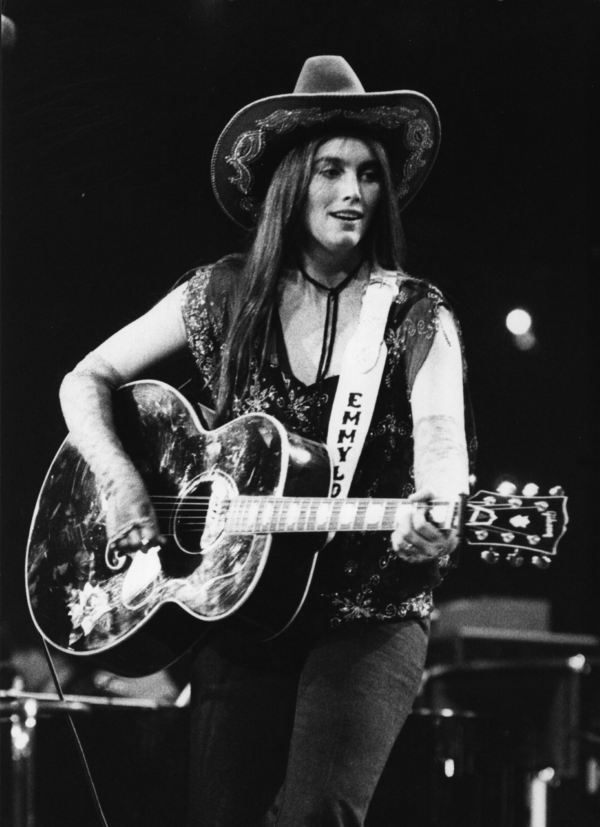
Emmylou Harris, “Luxury Liner”
Released at the tail end of 1976, “Luxury Liner” was Emmylou Harris’ fourth solo album and still stands as one of her most engaging and esteemed. The aching beauty of her voice is vividly captured in Harris renditions of the Jimmy Work-penned “Making Believe,” Rodney Crowell’s “You’re Supposed To Be Feeling Good” and Harris’ goosebump-inducing version of the Louvin Brothers’ classic “When I Stop Dreaming.”
She enchants just as much on her country-rocking remake of Chuck Berry’s “(You Never Can Tell) C’est La Vie” and the album’s combustible title track as on her definitive version of Townes Van Zandt’s “Pancho & Lefty.” Harris’ incandescent singing, a marvel of vulnerability, is a consistent joy.
Her all-star group of accompanists — which includes Crowell, Dolly Parton, Ricky Skaggs, Mickey Raphael and ace guitarists Albert Lee and James Burton — provide additional depth and luster. Harris’ marvelously emotive voice, combined with her admirable knack for choosing and essaying consistently superior songs, make “Luxury Liner” a wonderfully rewarding journey that deserves to be taken again and again.
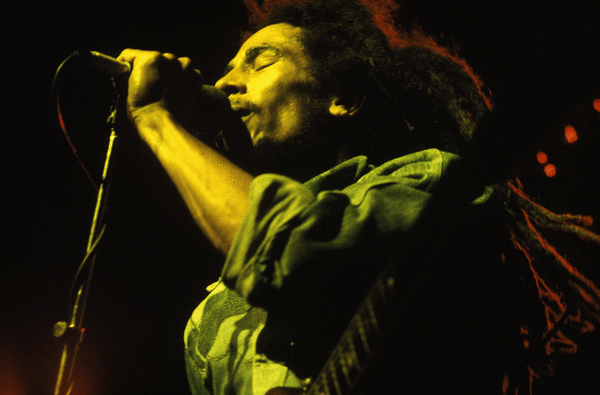
Bob Marley & the Wailers, “Rastaman Vibration”
Has there been a year from the 1970s so far when an album by Bob Marley hasn’t been included on my list of favorites? I can’t think of one.
“Rastaman Vibration” was Marley’s second consecutive album after the departure from the Wailers of Peter Tosh and Bunny Wailer, and this 11-song collection finds him in peak form from start to finish. Three of the numbers — “Roots Rock Reggae,” “Rat Race” and the hypnotic title track — soon became staples of Marley’s concert repertoire.
The album also contains several choice selections that rank among the most lyrically stark and socially charged in Marley’s oeuvre. “War,” “Crazy Head” and “Who the Cap Fit” seethe with righteous despair at political and racial inequities. He has rarely sounded as angry, or dismayed, as on “Want More,” which ranks alongside the O’Jays’ classic “Backstabbers” as a standout song decrying duplicity and betrayal. Just as formidable is “Night Shift,” an autobiographical gem inspired by Marley’s 1966 tenure as a forklift operator at a Chrysler factory in Delaware. He returned to his native Jamaica the following year to focus on music and never looked back.
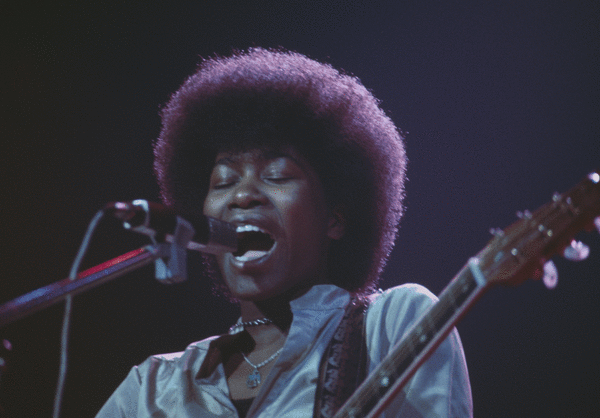
Joni Mitchell, “Hejira”
Although the oft-imitated Joni Mitchell recorded more breakthrough albums than any other singer-songwriter of her generation not named Bob Dylan, “Hejira” still stands out for its musical excellence, daring, sophistication and unwavering devotion to exploring new creative vistas. Or, as Mitchell herself once put it: “I suppose a lot of people could have written a lot of my other songs, but I feel the songs on ‘Hejira’ could only have come from me.”
No argument there.
Coming on the heels of her audacious 1975 album, “The Hissing of Summer Lawns,” the nine-song “Hejira” found Mitchell embracing her love for jazz and sonic adventure in equal measure. She is aided greatly by saxophonist Tom Scott, vibraphonist Victor Feldman, drummer John Guerin and the other members of Scott’s band, the L.A. Express, and even more by Weather Report bassist Jaco Pastorius and the remarkably nimble guitarist Larry Carlton.
The music is often spare but as eloquent, richly nuanced and filled with unexpected twists and turns as Mitchell’s peerless singing and lyrics. Inspired by a coast-to-coast road trip, she ruminates about earthy topics and mystical ones. She sings about a metaphorical crow, inadequate men, desert motels, blues pioneer Furry Lewis, the tug-of-war between craving both love and independence, and a coyote (in actuality, playwright and actor Sam Shepherd, with whom she had a fleeting affair)
And with the album-opening “Amelia,” on which she draws parallels between herself and the famed but doomed aviator Amelia Earhart, Mitchell offers an opening verse more evocative than many short stories: I was driving across the burning desert / When I spotted six jet planes / Leaving six white vapor trails across the bleak terrain / Like the hexagram of the heavens / Like the strings of my guitar / Amelia, it was just a false alarm.
The Mighty Diamonds’ “Right Time”
I was immediately enchanted upon first hearing the 1976 debut album by the Jamaican vocal trio the Mighty Diamonds. I still am today.
Lead singer Donald “Tabby” Shaw, who was murdered in 2022, had one of the sweetest tenor voices of any roots-reggae artist. He was perfectly teamed with Lloyd “Judge” Ferguson and Fitzroy “Bunny” Simpson, whose supple harmony singing drew inspiration from vintage American doo-wop and soul. The result at times suggests what The Temptations or The Impressions might have sounded like if they hailed from Kingston, rather than, respectively, Detroit and Chicago.
The Mighty Diamonds’ songs on “Right Time” poignantly address such topics as love, spirituality, oppression and racial and economic inequities. The lamentation “Why Me Black Brother Why?” evokes chills, as does “Go Seek Your Rights.”
But the trio’s superbly modulated delivery eschewed stridency in favor of honeyed vocals that made even such dark lyrical couplets as “Weeping and wailing and mourning and gnashing of teeth” sound almost cheery to anyone not paying attention to the words. The fact that this was the first album to prominently feature drummer Sly Dunbar and Robbie Shakespeare — who went on to become one of the world’s most acclaimed and in-demand rhythm sections — is an added bonus.
Milton Nascimento, “Geraes”
Like many Americans, I first discovered the angelic singing and sublime songwriting of Brazil’s Milton Nascimento on “Native Dancer,” the classic 1975 album by saxophone icon Wayne Shorter. During Union-Tribune interviews in 1990, Nascimento’s praises were sung to me by Tracy Chapman, David Byrne and Pat Metheny, who had recorded multiple times with Nascimento. “Milton sings like nobody else on Earth,” Metheny said at the time. “He writes beautiful songs and he has this incredibly powerful force.”
Blessed with a wondrous, full-bodied tenor that easily rose through two full octaves of falsetto, Nascimento sings primarily in his native Portuguese but speaks volumes even to those who, like me, can’t speak the language. His songs can be simple and complex, rootsy and elegant, foreign and familiar, sometimes seemingly all at the same time. And when he uses his exceptionally agile voice to sing wordlessly, goosebumps often result.
“Geraes” is Nascimento’s eighth album and came out four years after his first masterpiece, “Clube da Esquina,” the stunning double-album he made with fellow Brazilian music innovator Lô Borges. Much like the eclectic melting pot that constitutes the Brazilian culture Nascimento grew up in, “Geraes” blurs the distinctions between bossa nova and pop, sacred music and baroque, folk and orchestral.
The album-opening “Fazenda” has a haunting beauty, as does the whisper soft “A Lua Girou” (“The Moon Turned”), a spare, soul-stirring adaptation of a traditional Bahian folk lament. Understated and intimate, much of “Geraes” is suffused with a penetrating sense of melancholy. A prime example is Nascimento’s mesmerizing vocal duets with Chico Buarque on “O Cio da Terra” and with Argentinian singing legend Mercedes Sosa on the exquisite, Violeta Para-penned “Volver a los 17” (“Back to 17”), which comes as close to heavenly as any love song in memory.
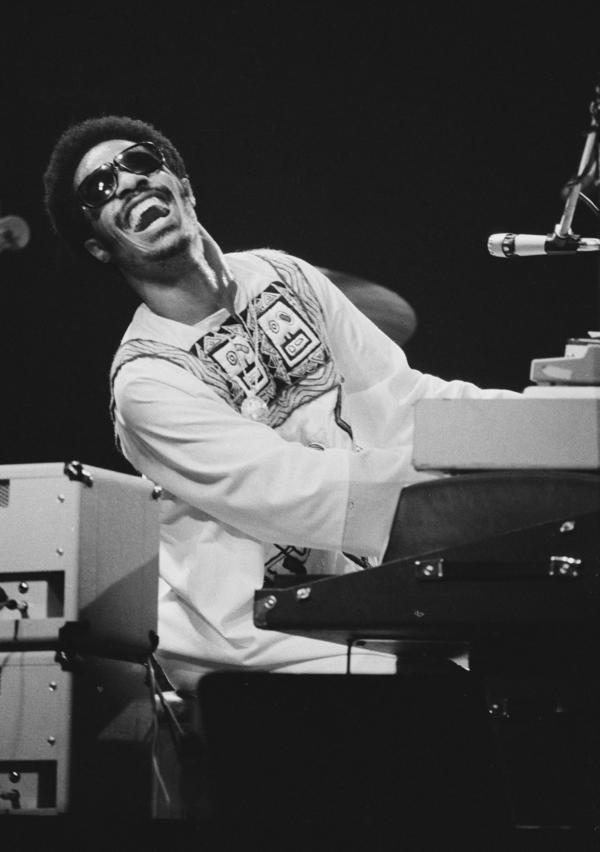
Stevie Wonder, “Songs in the Key of Life”
A figurative and literal sense of liberation imbues “Songs in the Key of Life,” Stevie Wonder’s stunning 1976 double-album. It was his 23rd album for Motown Records, the seminal label that released his 1962 debut long-player, “The Jazz Soul of Little Stevie,” when he was just 12 years old.
After making five classic albums in between 1970 and 1974 — including both “Talking Book” and Innervisions” in 1972 alone — Wonder could have taken the rest of the decade off and still ensured an enduring legacy. Instead, he gifted his listeners with “Songs in the Key of Life,” a 21-track epic that topped the national Billboard charts for 11 weeks and earned him four Grammy Awards, including for album of the year.
Significantly, “Songs” was his first album on which Motown Records’ honcho Berry Gordy Jr. finally gave Wonder carte blanche to call all the shots himself, with no corporate interference whatsoever. Wonder responded by making the most liberating, thoughtful, adventurous and eclectic work of his career.
With consistent skill, imagination and taste, he embraced a panoply of styles and made them indelibly his own as he built on his soul, rock and funk foundation by adding elements of salsa, country chamber pop, bossa nova, jazz-inflected ballads and more.
“Sir Duke,” his big band-inspired tribute to Duke Ellington, is a delight. So is the lilting “Isn’t She Lovely,” which Wonder wrote to celebrate the birth of his daughter, Aisha. The spiraling fusion-jazz instrumental “Confusion” easily matches anything done in the mid-1970s by Return To Forever or Mahavishnu Orchestra, while the slow-building ballad “Joy Inside My Tears” neatly encapsulates Wonder’s ability to eloquently convey his hopes and fears in equal measure.
On song after song, he sounds like an artist exulting in his creative freedom. Even casual listeners should recognize such favorites as “I Wish,” “Love’s In Need of Love Today,” “As” and “Pastime Paradise” (which provided the musical foundation for rapper Coolio’s 1995 hit, “Gangsta’s Paradise”). But such deep cuts as “Black Man,” “Have A Talk With God,” “Ordinary Man” and “All Day Sucker” reaffirm that “Songs in the Key of Life” excels from its very first note to its very last.
©2026 The San Diego Union-Tribune. Visit sandiegouniontribune.com. Distributed by Tribune Content Agency, LLC.








Comments