Review: In 'Giant' on Broadway, John Lithgow plays Roald Dahl in a fight over antisemitism
Published in Entertainment News
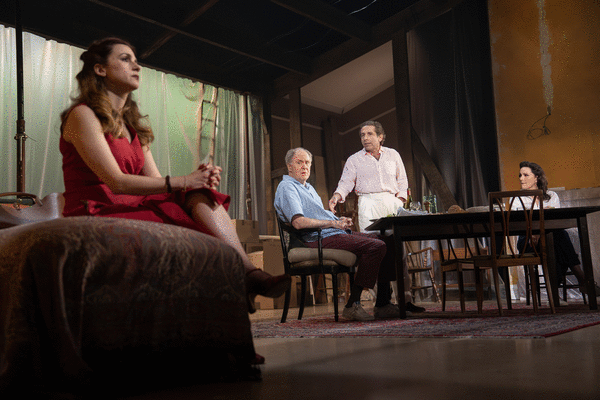
NEW YORK — In the summer of 1983, the British author Roald Dahl published a book review in the Literary Review that, to many eyes, revealed the beloved author of the juicy kids’ classics “Charlie and the Chocolate Factory” and “James and the Giant Peach” to be an unconscionable antisemite.
The review, written in the wake of the Lebanon War of 1982, started out by criticizing Israel’s actions and lamenting the dead in Lebanon, but immediately pivoted to an excoriation of the Jewish people en masse: “Never before in the history of man has a race of people switched so rapidly from being much-pitied victims to barbarous murderers,” Dahl wrote. “Never before has a race of people generated so much sympathy around the world and then, in the space of a lifetime, succeeded in turning that sympathy into hatred and revulsion.”
That is the jumping off point, for want of a better word, for “Giant,” the shrewdly penned and rather compelling new Broadway play by Mark Rosenblatt that has arrived from London’s West End. Directed by Nicholas Hytner and designed with adroit wit by Bob Crowley, “Giant” stars John Lithgow, a celebrity actor whose work as a serial killer on “Dexter” long ago made clear he would never be one to insist on an empathetic character. We can start by thanking God for that.
What we have here is, in essence, a furiously verbose debate play revolving around two very prescient questions. One is the degree to which criticism of the actions or the existence of the State of Israel inevitably slides into antisemitism, a debate that rages daily. The other is the extent to which the work of a great artist should be judged, admired or published without regard to their personal views. We still argue over that, too.
At the Music Box Theatre, we’re in Dahl’s Buckinghamshire garden watching two publishing executives trying to do damage control. At the time, of course, Dahl was a celebrity author with millions of copies sold and a new book, “The Witches,” coming out. Even in those long-ago days before instant social media outrage and immediate cancellation, booksellers and librarians were getting jittery and reporters were teeing up stories and looking for other examples of antisemitic or racist symbolism in Dahl’s work, the portrayal of the Oompa-Loompas being a prime example. The panicked publishers want Dahl to back down and, at a minimum, walk the review back.
Dahl, buoyed by his success, his indignation on part of the dead Lebanese civilians, and his disdain for compromise and expediency, thinks differently.
In Rosenblatt’s telling, Dahl’s assimilative British publisher, Tom Maschler (Elliot Levey), functions like Uncle Max in “The Sound of Music,” just wanting everyone to get along. He wants Dahl to appreciate the commercial risks and to do what he has to do to keep the sales flowing. But Jessie Stone (Aya Cash), the more strident sales director at Farrar, Straus and Giroux, Dahl’s American house, has no patience for that. A moralist just as articulate as Dahl, she wants not so much to protect sales but for Dahl to feel the pain he has caused to his Jewish readers by his bias — those like her who read “James and the Giant Peach” as kids with illicit bedroom flashlights.
“You understand the power of language more than anyone!” she roars, Cash rising to the occasion. “How it can twist things out of shape.”
Lithgow’s tricky, sneaky, determined Dahl is unmoved by either set of entreaties and smells censorious deception but, being a mercurial intellectual cushioned by success, he also relishes having the argument. So the Broadway audience gets a banger of one, with Dahl’s fiancé (played by Rachael Stirling) and his Australian housekeeper (Stella Everett) watching aghast. Unsurprisingly, the best scenes are when Lithgow’s Dahl and Cash’s Stone blast away at each other. Both of those leading performances are riveting.
To some extent, Rosenblatt is talking a leaf from the Peter Morgan playbook of using newsy real-life controversies with direct contemporary applicability to spark balanced, nuanced drama. And, as you might imagine, director Hytner is very adept at that.
In this case, of course, recent events in Iran only have made the play seem more timely. To its credit, the play makes a good argument for Dahl’s merit. “In his books, he picks a glorious, playful path through the chaos of childhood. It’s the rarest of gifts,” Maschler argues as Levey finds his best moment. “To show its cruelty but take you out the other side. And the more kids feel guided by his books, the more boldly they’ll read as adults, traveling way beyond the narrow crap their parents told them to sit with braver minds in ever richer worlds.”
That’s true, of course. (I speak as a fan of Dahl.) It also explains the success of J.K. Rowling’s “Harry Potter” series, but that would be another play, albeit perhaps one with some similarities to “Giant,” friendly or otherwise.
Resolution turns out to be more difficult for Rosenblatt, which is why Act 1 is stronger here than Act 2, especially after Stone gets banished to another part of the grounds. That said, Act 2 does explore how it is very different to be Jewish in the U.K. than in the U.S., not something all American Jews fully appreciate. It also brings up yet another fascinating question, which is how writers and artists often say or write or do their most controversial things when they are aged.
So are they finally showing their true, unvarnished selves or do they merit the consideration of age and seniority?
That one, like everything else here, gets a fair hearing here on both sides.
———
At the Music Box Theatre, 239 W. 45th St., New York; gianttheplay.com.
———
©2026 Chicago Tribune. Visit chicagotribune.com. Distributed by Tribune Content Agency, LLC.









Comments