Q&A: Ethan Hawke on his first best actor Oscar nomination: 'It's been a long road'
Published in Entertainment News
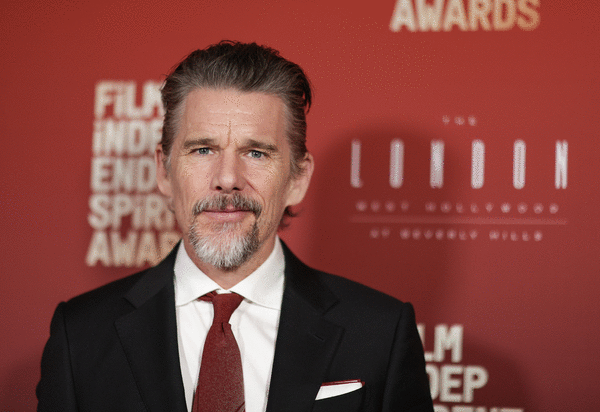
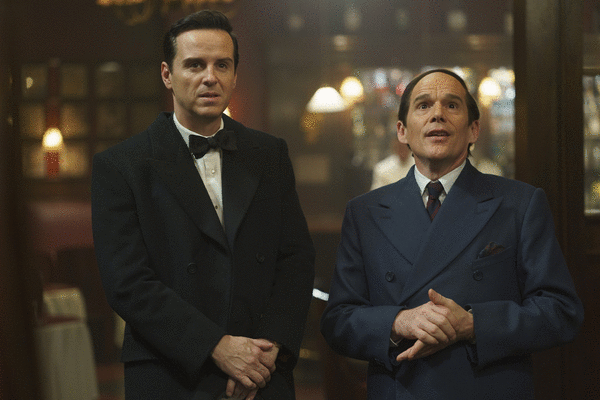
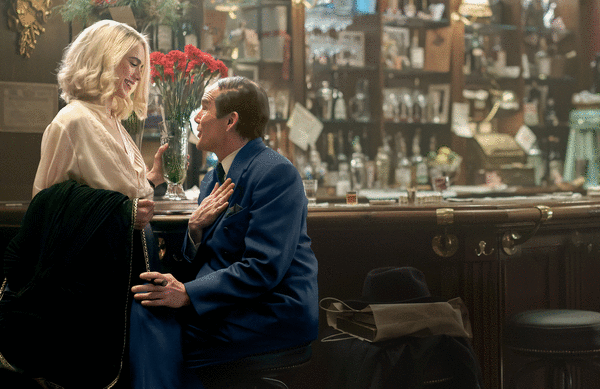


LOS ANGELES — Ethan Hawke has been nominated for an Oscar for lead actor for his role in “Blue Moon,” directed by Richard Linklater from a screenplay by Robert Kaplow. In the film, Hawke plays lyricist Lorenz Hart, who wrote the sharp, witty words to such standards as “My Funny Valentine” and “Blue Moon.”
The drama captures one night with Hart near the end of his life as he waits at Sardi’s for his former songwriting partner Richard Rogers (played by Andrew Scott) to arrive for a party celebrating the premiere of “Oklahoma!” By turns funny and self-pitying, full of regrets, disappointments and thwarted ambitions, Hart is portrayed by Hawke as a man who has often been his own biggest obstacle and is coming to realize his time has passed him by.
Hawke had been previously Oscar-nominated for supporting actor in 2001’s “Training Day” and 2014’s “Boyhood” — and for co-writing “Before Sunset” and “Before Midnight.” He has been acting professionally since he was a teenager, with an extensive list of credits that includes “Dead Poets Society,” “Reality Bites,” “Gattaca,” “Hamlet,” “Before the Devil Knows You‘re Dead,” “First Reformed” and many more.
Speaking on the phone during the morning of the Oscar nominations from his home in Brooklyn, the 55-year-old Hawke showed no signs of slowing down, as he was heading to Park City, Utah, the next day for the Sundance Film Festival. His new project, “The Weight,” starring Hawke and produced by his wife Ryan Hawke, would be premiering there and Hawke would also be speaking at a tribute to Robert Redford.
“It is true that this last year is one of the hardest working years of my life,” said Hawke. “I went from ‘Blue Moon’ straight to ‘The Lowdown’ straight to ‘The Weight.’ Somehow figured ‘Black Phone 2’ in there. I worked my ass off the last year. Ask my kids; they’re not happy about it.”
Q: You recently did an interview where you said you thought you were maybe doing too many interviews. So I guess I apologize in advance.
Ethan Hawke: It’s just funny, the amount of energy it takes to kind of penetrate the zeitgeist today is a lot more than it used to be. I hate to sound like an old man, but it used to be you go on “Letterman” and everybody knew about your movie. And now it’s like, wow. It’s just a lot different.
Q: Congratulations on your nomination today. Were you watching the announcements? How did you find out?
Hawke: I don’t do that to myself. I found out because my wife woke me up and told me. I let myself try to sleep in so that I could try to avoid the stress.
Q: This is your fifth Oscar nomination, but the first for best actor. What does that mean to you?
Hawke: Embarrassingly enough, it means a lot. I’ve dedicated my life to this profession and our culture places a high value on that. And it means a lot to me. Frankly, I don’t think I would’ve thought when I did “Training Day” that it would take me so long to get there. It’s been a long road.
Q: It’s such a great year for movies and you talk with such passion and conviction — almost as an ambassador of movies — about how important they are to you. You seem like you’re like cheerleading for everybody else as much as promoting your own work.
Hawke: I feel that way, sincerely. I appreciate you saying that because I do think that’s kind of the job of these award shows and things. We are ambassadors for our profession. Everybody knows that competition and the arts — it’s a game and a lot of great things go unnoticed in their time. And time is the great curator, of course. But movies need a boost and it’s part of our job to create substantive, meaningful entertainment for people to have serious conversations and interesting things to think about and talk about and push the consciousness forward. And so I feel really proud of all these movies that were nominated and tons of them that weren’t, that are all doing their job.
Q: The fact that this nomination comes from a film you’ve made with Richard Linklater, who you’ve worked so closely with over the years — does that make it even more special?
Hawke: I couldn’t articulate that clear enough. It feels so wonderful to get this for a movie that was made so organically and rose up through not through the prism of business, but through the prism of friendship. Robert Kaplow is a brilliant screenwriter and Rick’s his friend, and we’ve been talking about this for a decade. And that’s the way all of the projects that I’ve done with Rick have happened, is they kind of are born out of friendship. And so to get to ring the bell with a film that really feels so connected to my life is particularly meaningful.
Q: What does that relationship with Richard mean to you?
Hawke: Words fail. I think that friendship is the substance of our life. When friendships or love affairs or collaborations happen the right way, they’re kind of effortless. And your life is richer because of them, not your work. Your life, your character is improved. I always like to tell my kids, you spend your life with your friends, so your friends are your life, so choose them wisely. They really shape you. And I’ve been really lucky to have a great friend who happens to be one of the definitive filmmakers of our era.
And I don’t take that lightly. Think about it, Rick has two — I know he doesn’t care, so it kind of makes it even more funny — but he had two of the best movies made this year [“Blue Moon” and “Nouvelle Vague”]. And he doesn’t win any prizes but it’s kind of a testament to what’s special about his filmmaking is that he disappears and lets the project appear and he doesn’t put his signature all over it. I was fortunate enough to work with Sidney Lumet and they’re reminiscent of each other in a way. They’re just completely dedicated to the work. And it’s wonderful to have a partner like that.
Q: What did you connect to about the character of Lorenz Hart?
Hawke: It’s deeper than just the character. It has to do with what the film’s kind of about. My love of the theater and my love of the people who dedicate their life to creativity and the kind of highs and lows of that life, and the silliness and stupidity of that life, and the moments of elegiac grace. I love what the film is about. It’s kind of a howl into the night of an artist being left behind. And indifference is kind of the feeling most of us in this profession feel most of the time, obviously not today, but most of our lives are met with absolute indifference.
And it also had the good fortune of the way Rick works. He’s so patient — we worked on it and dreamed about it for 10 years. And we knew it was fragile. We knew it was delicate. We knew the bull’s-eye was extremely small. It’d be an easy movie to make badly. So it was entirely execution-dependent. And that’s the fun of Rick is he loves to think about it.
Q: You shaved your head for this. Were you confident it was going to grow back?
Hawke: No. At my age you’re like, “Wait a second, is this just a giant mistake?” But we knew we had to get the look right. So we were all in.
Q: You just seem like you’re in such an incredible position right now in your career, you’re making projects like “Blue Moon” and “The Black Phone” movies, you’re doing TV work, you can direct your own projects like “Wildcat” or “The Last Movie Stars,” about Paul Newman and Joanne Woodward. How do you see where you are right now?
Hawke: It feels really good because I have a lot more I want to do. I’ve started to feel like one lifetime’s not enough for this profession and that there keeps being so much to learn. I get more excited about the possibilities of how storytelling can impact our culture and what the responsibilities are with that and how much fun I’ve had. I’ve really had a ball — my whole career I’ve gotten to do things the way that I wanted to do them.
And it’s kind of thrilling for me to watch Stellan [Skarsgård] this year and like get inspired. I mean, he’s a proper grown-up and he’s humble and so gifted and had such an amazing career. And it makes me really excited about the future. I’ve always had these huge actors I’ve admired, Christopher Plummer, Jason Robards, people who’ve learned how to grow up and be an adult in this profession. That’s what I’m trying to do. So I feel like that’s the moment you’re finding me in.
Q: Because it seems at this point that you’re always working. Do you ever think about just taking a break?
Hawke: I’ve been always working since ’89. The thing is, I just love it. My wife and I have this little production company and we both just love to work and make things and try to sneak things into the atmosphere that might not exist otherwise. And it’s how you define work, right? Most of the time it’s not work for me. I loved making “Blue Moon.” When I’m on a set with Richard Linklater, I am exactly where I want to be. My relationship with my work is one where I wouldn’t want to take a year off because I wouldn’t know what to do.
Q: I’ve noticed a lot of people, when they talk about you, they say they used to find you annoying — who does that guy think he is, writing a novel or directing a movie? — but that they’ve come to really respect and admire you for the fact that you try to do so many different things and you’ve really kept at it. How do you feel about it when you hear people talk about you in that way?
Hawke: I think they’re right too. It’s a general suspicion and if you can’t withstand that suspicion, then you should stop. Like you have to pass through that if you’re serious and you have to be willing to be criticized, to be made fun of. It’s a small luxury tax for getting to do it. You really want to be doing it because you want to offer something. And so if you’re offering it, then people can do with it whatever they want. They can throw it away. They don’t have to take it.
I think some of the stuff that was happening to me when I was younger, facing that attitude was really actually good for me. I mean, I hated it. We all want to be liked and understood and for people to understand our intentions and know that our aim is true and we’re coming from a good place. All of us crave that. But you just can’t give it too much credit. And you’ve just got to keep putting one foot in front of the other.
©2026 Los Angeles Times. Visit at latimes.com. Distributed by Tribune Content Agency, LLC.








Comments