US Senate votes to end mine ban near Boundary Waters; signature from Trump expected
Published in News & Features
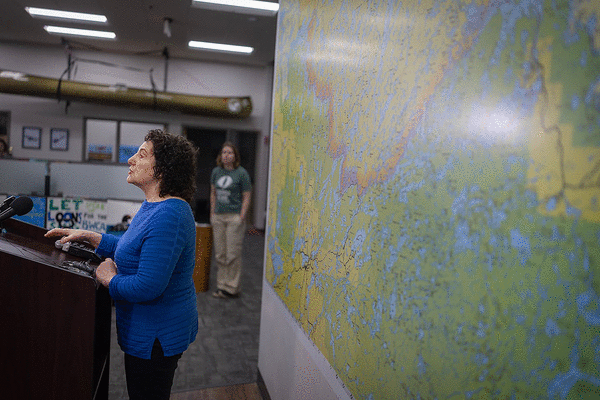
The U.S. Senate has voted to repeal a ban on mining next to northern Minnesota’s Boundary Waters Canoe Area Wilderness. The vote sidelined a centerpiece strategy for conservationists who had waged a national campaign to put the protection in place and, in recent weeks, to defend it.
President Donald Trump, who campaigned on reinvigorating mining in Minnesota, is expected to sign the resolution. That means that a prohibition against mineral leasing on 225,000 acres of land in the Superior National Forest, put in place under former President Joe Biden, will be dead. Only a future act of Congress could resurrect it.
“A major victory for America and Minnesota’s 8th Congressional District was secured today,” Rep. Pete Stauber, R-Minn., posted on X shortly after the vote. “Mining is our past, our present, and our future – and the future looks bright!"
The vote on Thursday marked a major win for Stauber, who represents the northeastern part of the state and who authored the resolution.
Mining boosters, including Stauber, say opening up the complex of copper and nickel found underground in this region is essential for the future of northeastern Minnesota as jobs in taconite mines on the Iron Range have continued their slow decline.
Waters in Superior flow to the Boundary Waters, to Voyageurs National Park and to Canada’s Quetico Provincial Park. Groups such as Save the Boundary Waters and Friends of the Boundary Waters Wilderness argue that mining for copper and nickel in this region is too risky because pollution could escape — and the U.S. Forest Service, under Biden, agreed. A federal study in 2022 concluded there was no way to mine without risking the Boundary Waters.
“This is a dark day for the Boundary Waters, no doubt, but also a dark day for public lands across the country,” said Ingrid Lyons, executive director of Save the Boundary Waters.
The resolution that passed was the first time the Congressional Review Act has been used to remove this kind of land protection, and there’s agreement across the political spectrum that it could be applied in the future to other public lands.
Supporters of the resolution urges that its passage does not mean companies will begin opening up the ground immediately.
“This vote does not open a mine. It opens the door for a transparent, science-based review,” Julie Lucas, the executive director of copper-nickel industry group Mining Minnesota, wrote in an email. “Mining and environmental protections can co-exist, and our industry is committed to making sure that happens.”
The vote and expected signature immediately raises the prospects of the mining company Twin Metals, which submitted its proposal for an underground mine between Ely and Babbitt to regulators back in 2019. After the Biden administration canceled Twin Metals’ federal mineral leases and then finalized the ban on new leases in 2023, the project stalled.
“Passage of the CRA marks a critical moment for our nation’s ability to strengthen our mineral supply chains,” Kathy Graul, a spokesperson for Twin Metals, wrote in an email.
The mine would produce an estimated 20,000 tons of ore a day, including copper, nickel, cobalt and platinum, and potentially employ 700 people. The investment in the project to date is more than $650 million. Only a few employees work for the company right now, as its fate has hung in limbo for years.
Twin Metals is owned by the Chilean mining conglomerate Antofagasta, a fact some Democratic senators used while arguing that the project does not put American interests first. A handful of other exploration companies have pulled samples from the area and may also benefit from the rollback.
Nothing will immediately change for Twin Metals, however. Even with the removal of the ban, the company will need to resolve legal issues around the federal mineral leases that were canceled. After that, the project will be at square one in the environmental review process — which already takes several years.
“The Twin Metals team looks forward to a robust discussion and engagement with our communities through any future regulatory processes,” Graul wrote.
Opponents say the fight is far from over, including Sen. Tina Smith, a Minnesota Democrat, who often cast the Twin Metals project as “the wrong mine in the wrong place.”
Smith spent weeks attempting to whip her GOP colleagues against the vote behind the scenes, and was joined by a coalition of environmental groups and tribal authorities. Minnesota’s Ojibwe tribes have a deep connection to the Boundary Waters and a treaty right to hunt, fish and gather there.
Smith spoke for hours against the vote on Wednesday night and returned to the floor on Thursday morning, joined at times by Sen. Amy Klobuchar and other Democrats.
Ultimately, the vote was 50 to 49, with the only Republican “no” votes from Sens. Susan Collins of Maine and Thom Tillis of North Carolina. Sen. Josh Hawley, R-Mo., was not present.
“It seemed like we had really close votes, and then, you know, the White House weighed in (on Wednesday), in particular,” Smith said in an interview after the vote.
One of Smith’s main arguments to her colleagues was that the process to roll back the mine ban wasn’t legal. Stauber introduced his original resolution under the Congressional Review Act, which is usually used within 60 days to remove a federal rule. But there is controversy about whether this ban actually counts as a rule, and whether the CRA can be used nearly three years after the original action.
Stauber refused to talk to a Minnesota Star Tribune reporter on Thursday about the precedent the vote could set. But some of his Republican colleagues in the Senate who voted for the measure acknowledged that it was unusual.
“I agree with the policy we’re talking about here, that’s why I voted for it, but I think we may have set a precedent here” by passing the resolution, said Sen. Lisa Murkowski, R-Alaska.
Advocates in Minnesota are now looking to press their case with state regulators, who will make key decisions on how, and if, a proposal from Twin Metals actually becomes a mine.
Friends of the Boundary Waters Wilderness has suggested that the state Department of Natural Resources already has the ability to cancel state mineral leases held by Twin Metals. “What the DNR does today, in 2026, builds the foundation to stop this dangerous mine at the state level,” said Pete Marshall, communications director.
Smith also said she expected “there will be lawsuits” because of the unusual use of the CRA.
“Whatever the outcome of this vote this afternoon, we will not stop fighting and we will not stop our work to protect the Boundary Waters,” Smith said on the senate floor shortly before the voting began. “It is a sacred place, and we will not stop defending it.”
_____
Christopher Vondracek, Bob Timmons and Greg Stanley of the Minnesota Star Tribune contributed to this story.
_____
©2026 The Minnesota Star Tribune. Visit startribune.com. Distributed by Tribune Content Agency, LLC






Comments