US, Iran seek more ceasefire talks as blockade stops ships
Published in News & Features
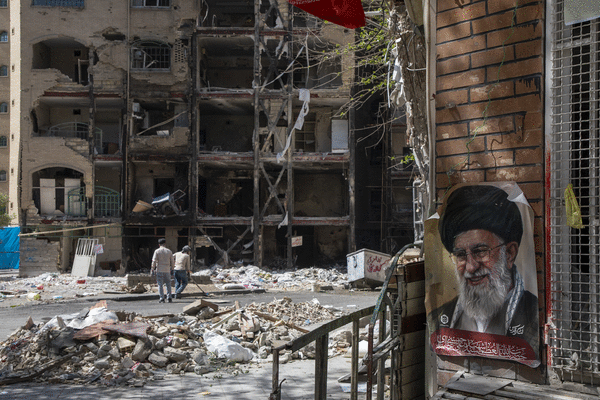
WASHINGTON — The U.S. and Iran are looking to arrange a second round of peace talks in the coming days, while a standoff in the Strait of Hormuz worsens a global energy crisis and complicates diplomatic prospects.
The objective is to hold more discussions before an April 7 ceasefire expires next week, according to people familiar with the matter. One proposal is to return to Pakistan, where initial negotiations were held last weekend, though other venues are being considered, said the people, who asked not to be identified discussing private deliberations.
U.S. President Donald Trump said talks could resume “over the next two days” in Pakistan, the New York Post reported. That would build on a marathon yet inconclusive session in Islamabad on Saturday night.
In the meantime, the U.S. is pressing ahead with a naval blockade of Hormuz to curb the Islamic Republic’s oil exports, as the battle for control of the strategic waterway intensifies.
The U.S. has arranged for 24-hour enforcement of the blockade with an armada of more than 12 vessels. That includes destroyers and the USS Tripoli amphibious warfare ship, accompanied by F-35 jets and Marine vessels for boarding operations, as well as the USS Canberra Littoral Combat ship that could help clear sea mines, as needed.
The vessels are concentrated in the Gulf of Oman instead of hugging Iran’s coast or actually in the Strait of Hormuz, a U.S. official said. Dispersal across the Gulf gives the U.S. more ocean area to maneuver and re-supply. It also allows the U.S. to avoid any Iranian anti-ship cruise missiles, and to board vessels using Marines if necessary, the official said.
The Trump administration will allow a waiver temporarily authorizing the purchase of certain Iranian crude oil to expire this weekend, the Treasury Department said Tuesday. A U.S. sanctions waiver authorizing purchases of Russian crude lapsed last week. Those efforts were aimed at easing the global energy shock from the six-week war.
Iran is considering a short-term pause to shipments through the strait to avoid testing a U.S. blockade and scuppering a fresh round of peace talks, according to a person familiar who sought anonymity to discuss Tehran’s private deliberations.
Stocks continued their climb, putting the S&P 500 Index within sight of a fresh record, amid optimism over prospects for peace talks. Brent crude ended the session almost 5% lower, just below $95 a barrel.
Still, retail gasoline and diesel prices in the U.S. are at their highest seasonal levels ever, a pain point for consumers ahead of summer travel.
Real-world crude markets continue to signal severe shortages. The world’s most important physical oil price, known as Dated Brent, is still trading above $120 a barrel.
The war has damaged Gulf energy infrastructure and disrupted oil and gas supplies beyond the region, rattling markets and triggering fears of a global inflation crisis. About a fifth of the world’s oil and liquefied natural gas was shipped through Hormuz before the start of the war.
Surging prices of products such as jet fuel and gasoline are already squeezing consumers, the International Energy Agency said on Tuesday, pointing toward the first annual decline in global oil demand since 2020.
The latest push for talks shows the two sides haven’t given up on diplomacy despite the failure of the initial Pakistan negotiations.
Switzerland said it’s ready to provide diplomatic support to efforts to end the conflict. The traditionally neutral country hosted talks about Iran’s nuclear program before the U.S. and Israel started bombing the Islamic Republic on Feb. 28.
Fighting has largely paused since shortly after the April 7 truce was agreed, giving further cause for optimism. The exception is in Lebanon, where Israel is continuing its military campaign against Iran-backed Hezbollah.
Talks between Israel and Lebanon began in Washington on Tuesday in an effort to resolve that parallel conflict, which has killed more than 2,000 people and displaced a million more, according to the Lebanese government.
Yechiel Leiter, Israel’s ambassador to the U.S., told reporters that it was a productive session, with the two governments in line on freeing Lebanon from “occupation” by Hezbollah.
The talks are separate from the negotiations between the U.S. and Iran facilitated by Pakistan, and have been in the works for a month — prior to the confirmation of the discussions in Islamabad, according to a State Department official. The negotiations hosted in Washington are part of a broader effort to eliminate Iran’s influence over Lebanon via its proxy Hezbollah, the official said.
Israel’s spy chief pledged more covert efforts to try to topple Iran’s government, suggesting the countries’ conflict will continue even if the U.S. agrees to a peace deal. “Our mission has yet to be completed,” David Barnea, the head of Mossad, said in a speech.
Trump’s restrictions on Hormuz represent a further test of the ceasefire’s durability. The U.S. said six merchant vessels complied with instructions to turn around and re-enter an Iranian port during the first day of its blockade.
“We can’t let a country blackmail or extort the world,” Trump said Monday, warning Iran against charging fees for vessels to transit the strait.
A ship under U.S. sanctions and linked to China sailed out of Hormuz and into the Gulf of Oman, testing the blockade. It wasn’t clear if the Rich Starry, a medium-range tanker, visited Iranian ports before its transit.
Blocking shipments through the strait poses risks for China, which remains Iran’s largest oil customer and a key trade partner. Beijing has called for an immediate ceasefire, warning that a blockade threatens global trade.
Indian Prime Minister Narendra Modi said he spoke with Trump to discuss the strait. Its closure has been particularly problematic for India, a major importer of fuels from the region. The White House confirmed the call without providing further details.
_____
With assistance from John Bowker and Devika Krishna Kumar.
_____
©2026 Bloomberg L.P. Visit bloomberg.com. Distributed by Tribune Content Agency, LLC.





Comments