Vance to Lead Iran talks as Tehran says ceasefire violated
Published in News & Features
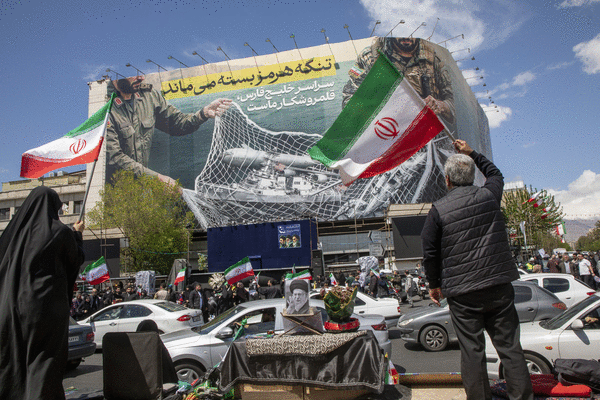
WASHINGTON — The White House announced the U.S. would hold direct talks with Iran even as continued fighting in the Middle East, punctuated by Israeli strikes in Lebanon, threatened to derail the fragile ceasefire in the six-week conflict.
Press secretary Karoline Leavitt said Vice President JD Vance would lead a U.S. delegation to Islamabad, which would include special envoy Steve Witkoff and Jared Kushner, with the first round of talks taking place Saturday morning local time.
Sporadic fighting, however, continued throughout the region, including in Lebanon, where Israel continued its campaign against the Iran-aligned Hezbollah militia. Iran officials cast that as violating the terms of the less than day-old ceasefire.
“The Iran–U.S. Ceasefire terms are clear and explicit: the U.S. must choose—ceasefire or continued war via Israel. It cannot have both,” Iran Foreign Minister Abbas Araghchi said in a social media post.
In a subsequent post, Iranian Parliament Speaker Mohammad-Bagher Ghalibaf cited the fighting in Lebanon, as well as claims of a drone entering Iranian airspace and the “denial of Iran’s right to enrichment,” saying that in such circumstances, a “bilateral ceasefire or negotiations is unreasonable.”
Further underscoring the fragility of the truce, Iran kept up strikes on Gulf states and the Strait of Hormuz remained largely blocked. President Donald Trump has said that reopening the strait is a condition for halting the fighting. Leavitt reiterated Wednesday that Trump expected the strait to be “reopened immediately.”
Iran’s semi-official Fars news agency reported that passage of oil tankers through the strait were halted after Israeli strikes. Vance countered that assertion, saying “we are seeing signs that the straits are starting to reopen.”
Vance, who was traveling in Hungary told reporters “we’re on the right track” in negotiations and pushed back on Ghalibaf’s statement, saying, “I actually wonder how good he is at understanding English” because some of his comments “didn’t make sense.”
The vice president said that Israel offered to “check themselves a little bit in Lebanon” during discussions with U.S. officials “because they want to make sure that our negotiation is successful.”
The Israeli military on Wednesday said it had carried out its largest operation against Hezbollah since the start of the Iran war, targeting more than 100 of the militia’s command centers and military sites within 10 minutes. Israeli Prime Minister Benjamin Netanyahu hailed a military campaign he said had set back the Iranian regime’s capabilities by many years but said the war had not ended.
Trump said earlier Wednesday that Lebanon was not part of the ceasefire but expressed confidence that campaign would not undercut the broader agreement. He told PBS that Hezbollah would “get taken care of, too. It’s alright.”
Trump’s announced ceasefire Tuesday night was a retreat from threats to unleash massive devastation on Iran, easing fears of a protracted global energy crisis.
Oil prices plunged more than 17% on Wednesday on news of the ceasefire agreement. Still, investors remained on edge and are bracing for prolonged disruptions to Middle East oil supplies as ships continue to avoid the Strait of Hormuz. Prices pared some losses after the Fars report. Brent and U.S. crude futures were trading near $95 a barrel by 2:41 p.m. in New York.
More than 800 freighters are stuck inside the Gulf, mostly waiting to leave, and shipowners and insurer groups have warned that more details will be needed to determine if safe transit is possible.
Trump made a series of confusing claims about the terms of the agreement on Wednesday morning, including a potential joint venture with Iran to collect tolls on vessels transiting the strait. Leavitt, however, downplayed expectations for that plan.
“That’s not something we’ve said that we’ve definitively accepted,” Leavitt said. “The joint venture is something that was proposed by the president, but he was very clear in his statement last night — he wants to see the strait reopened, immediately, without limitation and that’s something we’re going to hold them to.”
Trump also said that the Islamic Republic has undergone a “regime change,” even though there have been no signs this week that new leadership had taken hold. He indicated the U.S. would use its own 15-point plan as the basis of negotiations with Tehran, after saying Tuesday the sides would begin discussions off of Iran’s 10-point proposal. Nonetheless, he said the U.S. was prepared to discuss with Iran much-desired sanctions relief.
Leavitt said that a previous 10-point plan from Iran was “fundamentally unserious, unacceptable and completely discarded,” but that they put forward “a more reasonable and entirely different and condensed plan” to the U.S. She indicated, however, that Trump’s “red lines” haven’t changed.
Iran’s demands include its continued control of Hormuz, acceptance of its nuclear-enrichment activities, the lifting of all primary and secondary sanctions, and a withdrawal of U.S. combat forces from the region, according to a statement by its Supreme National Security Council carried by state media.
Despite the ceasefire announcement, countries including Kuwait, Bahrain and the United Arab Emirates, as well as Israel, reported ongoing missile attacks into Wednesday, sewing confusion about how the deal would be enforced. Saudi Arabia’s oil pipeline to the Red Sea was hit by a drone strike, according to a person familiar with the matter.
Trump’s ceasefire announcement represented a dramatic climb-down from an warning earlier Tuesday that “a whole civilization will die tonight, never to be brought back again” if Iran didn’t give in. His threatened attacks on Iran’s civilian infrastructure, including power plants, may have been considered war crimes if they were carried out. More than 5,300 people have died in the near six-week war.
In a social media post, Trump said “there will be no enrichment of uranium” — a reference to longstanding efforts by Washington and Israel to curb Iran’s nuclear program. Netanyahu said Wednesday that highly enriched uranium would be removed from Iran, one way or another.
Trump also announced plans to impose 50% tariffs on U.S. imports from any country that sold weapons to Iran. It’s unclear how he would follow through on that threat, since the Supreme Court curbed his authority to impose certain levies unilaterally.
While markets have breathed a sigh of relief, the ceasefire addressed a crisis Trump helped create when the U.S. and Israel launched the war in late February. Although Trump claimed to have stopped Iran’s nuclear program, there’s been no mention of its missile or drone programs or support for proxy groups.
Vance said at an event in Budapest that Trump has achieved Washington’s military objectives in Iran, having set out to “decimate” Iran’s ability to wage conventional war, while describing the truce as “fragile.”
_____
(With assistance from John Bowker, Devika Krishna Kumar, Courtney Subramanian, Kate Sullivan and Josh Wingrove.)
_____
©2026 Bloomberg L.P. Visit bloomberg.com. Distributed by Tribune Content Agency, LLC.




Comments