'Ketamine queen' gets lengthy prison sentence for selling drug that killed Matthew Perry
Published in News & Features
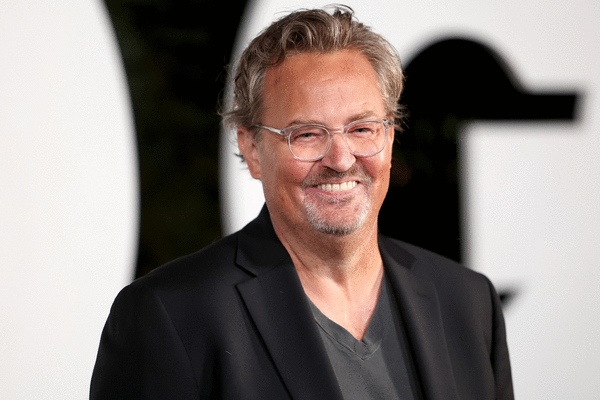
LOS ANGELES — A woman known as the "Ketamine queen" who provided the drugs that killed actor Matthew Perry was sentenced Wednesday to 15 years in federal prison.
Jasveen Sangha, who prosecutors said operated a high-volume drug trafficking business out of her North Hollywood home, pleaded guilty in September to one count of maintaining a drug-involved premises, three counts of distribution of ketamine and one count of distribution of ketamine resulting in death or serious bodily injury.
Sangha, 42, was one of five people charged with conspiracy to distribute ketamine to Perry, who died from acute effects of the drug.
During the sentencing hearing, U.S. District Judge Sherilyn Peace Garnett said that of the charged defendants tied to Perry's death, Sangha was "probably one of the most culpable."
"This is not a reflection of you being a bad person," Garnett said. "This sentence is a reflection of you engaging in illegal conduct."
Sangha covered her mouth with her left hand as the judge handed down her sentence, which included three years of supervised release. More than 50 people had packed into the courtroom, and as Sangha left, she waved at her family in the gallery and blew them a kiss.
Authorities say Sangha sold about 50 vials of ketamine to Perry for $11,000 — including the batch that led to his October 2023 death at 54. In her plea agreement, Sangha admitted to knowingly distributing ketamine to Perry, whose struggles with drug addiction and numerous rehab visits were well documented.
Sangha also admitted to selling four vials of ketamine to Cody McLaury in August 2019. McLaury, 33, died hours later in his Los Angeles home from a drug overdose that authorities said included ketamine as a factor.
Sangha, dressed in a light-colored jail jumpsuit, her shackles clinking as she walked to the podium to address the court, said that "the rug of life was ripped out from under me." She cited her "poor choices" and addiction as factors in her behavior.
"Not a day goes by that I don't think about my actions," she said. "I'm deeply ashamed. I am so very sorry … I pray for forgiveness every day."
Sangha called the experience "the harshest reality check of my life."
During the hearing, Perry's stepfather, Keith Morrison, told Sangha that he doesn't hate her. "I'm not angry at you," he said.
But Morrison told Sangha that she had "supplied an addict," and that all of Perry's possibilities "died with him."
"He had so much more to give," Morrison said, as Sangha cried.
McLaury's sister also spoke, noting that Sangha "didn't feel bad enough to stop when my brother died."
"You being caught is the only thing that stopped you," she said.
In a sentencing memorandum ahead of the hearing Wednesday, Sangha's defense attorneys, Mark J. Geragos and Alexandra Kazarian, noted that their client had no prior criminal history and had been incarcerated since August 2024. They asked the judge to sentence Sangha to time served.
During the hearing, Geragos said "there was nobody who was going to stop Mr. Perry from doing what he was going to do."
"Once they're in the throes of addiction, that's it," he said.
Two defendants have yet to be sentenced, including Perry's former personal assistant Kenneth Iwamasa. Salvador Plasencia, a former physician who supplied ketamine to Perry in the weeks leading up to his death was sentenced to serve 30 months — about two and a half years — in prison. Mark Chavez, another former doctor who played a role in providing the actor ketamine, was sentenced to eight months of house arrest.
Prosecutors in their sentencing memo described Sangha as a "privileged individual" with a financially stable life.
The prosecutors wrote that Sangha "elected not to make use of her privileged background for the better. In fact, unlike many defendants who traffic drugs against a humble backdrop marred by childhood and family difficulties, defendant chose to deal drugs not because of financial deprivation, but for greed, glamor, and access."
They accused Sangha of trying to "rewrite history" to paint herself as the victim and said she had not demonstrated remorse.
"She repeatedly sold dangerous drugs in high volume; she ran a stash house and directed others to help sell her drugs; she obstructed justice to conceal her actions; and she was fully aware that her drug dealing contributed to at least two deaths — yet kept selling the drugs to others," the prosecutors wrote.
Prosecutors also cited a recorded jail call of Sangha discussing obtaining "trademarks" and securing book rights based on the events of the case. Even if in jest, prosecutors said, the conversation suggested Sangha "does not appreciate the severity of her offenses, and instead sees her crimes as a potential future revenue stream."
"Without a doubt, Ms. Sangha is the most culpable defendant in this case," Assistant U.S. Attorney Ian Yanniello said Wednesday.
©2026 Los Angeles Times. Visit at latimes.com. Distributed by Tribune Content Agency, LLC.




Comments