How a Hugo Chávez loyalist resurfaced as producer on the 'Melania' documentary
Published in News & Features
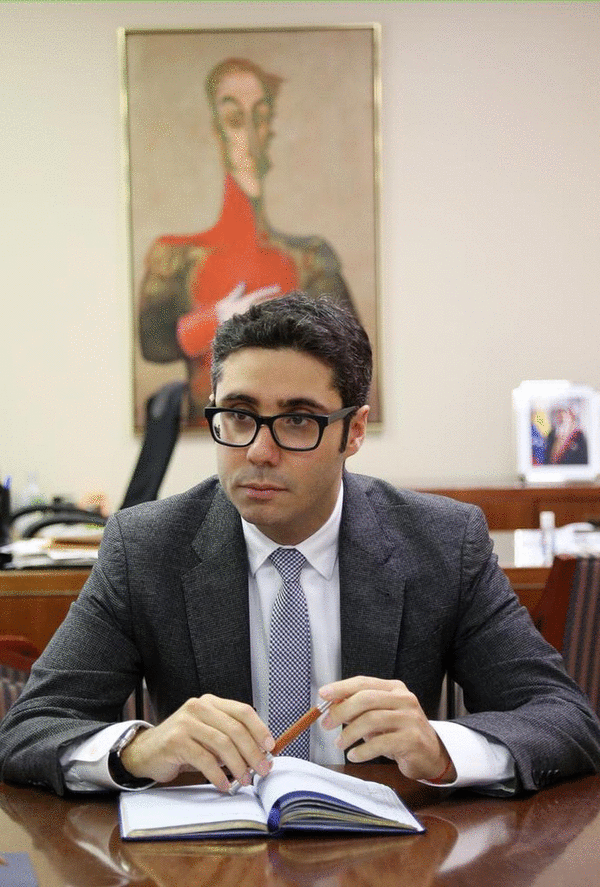
The credits roll, the lights dim, and on screen appears a name few in the audience would recognize — yet it’s one that once moved quietly through the highest levels of power in Venezuela.
Maximilien Sánchez Arveláiz, a former insider in Hugo Chávez’s government and a figure later touched by one of Latin America’s largest corruption scandals, has resurfaced in an unlikely place: as a film producer tied to a high-profile documentary project about first lady Melania Trump.
The transformation is not just surprising — it is emblematic of a broader pattern.
Sánchez Arveláiz is listed as a co-producer of “Melania,” the glossy, multimillion-dollar documentary project about the first lady — a film backed by major distribution money. To most viewers, it is just another name in a long list.
But to those familiar with Latin American politics, it is something else entirely.
“What’s surprising is not that there’s a Venezuelan in this project,” said Venezuelan columnist Alejandro Hernández, who has tracked his trajectory. “It’s that it’s him.”
Because Sánchez Arveláiz is not simply a filmmaker. He is a former insider in Hugo Chávez’s government, a diplomat who operated at the highest levels of Venezuela’s foreign policy apparatus, and a figure later linked to one of the largest corruption investigations in the region.
His journey — from the ideological trenches of the Caracas socialist regime to the cultural corridors of Hollywood — offers a rare window into how power, influence and reinvention intersect across borders.
Sánchez Arveláiz did not respond to an email from the Miami Herald seeking comment.
The architect behind the image
Long before he appeared on film credits, Sánchez Arveláiz was helping construct narratives of a different kind.
Born in Paris to a Venezuelan mother and educated in elite European institutions, he immersed himself early in the intellectual foundations of Chávez’s political project. His graduate thesis in London focused on the Venezuelan leader and the promise of a “rearmed utopia” of the Latin American left.
He did not stumble into Chávez’s orbit. He pursued it.
In 2001, Arveláiz organized a high-profile forum at the Sorbonne University in Paris that brought Chávez into direct contact with European intellectuals. The event proved decisive. Chávez took notice — and soon brought Sánchez Arveláiz into his inner circle.
From there, Sánchez Arveláiz rose quickly, eventually becoming director of international relations in the presidential office, a position that analysts describe as functioning like a parallel foreign ministry reporting directly to Chávez.
“He was one of Chávez’s favored insiders — someone trusted to connect him with intellectuals, politicians and even Hollywood figures,” Hernández said.
That role placed him at the center of a broader effort to reshape Chávez’s global image.
Through carefully cultivated relationships with filmmakers, celebrities and political allies, the Venezuelan government sought to present its leader as a modern, democratic socialist — a narrative that resonated in parts of Europe and the United States during the early years of the Chavez’s Bolivarian revolution.
Few individuals were more central to that effort than Sánchez Arveláiz.
According to internal analyses and diplomatic accounts, he helped orchestrate meetings with figures ranging from Latin American presidents to American cultural icons such as Oliver Stone and Sean Penn, weaving together a network that blurred the lines between politics, culture and influence.
The Brazil years and Lava Jato
If Sánchez Arveláiz helped build Chávez’s international image, his time in Brazil exposed the deeper mechanics behind that influence.
Appointed Venezuela’s ambassador to Brazil in 2010, he arrived at a moment when leftist governments dominated much of the region and Venezuela’s alliances were at their peak.
Behind the scenes, however, investigators would later uncover a different story.
Brazilian court documents linked Sánchez Arveláiz to financial operations tied to the 2012 reelection campaign of Chávez, involving at least $12 million from construction giants Odebrecht and Andrade Gutiérrez.
Witness testimony described a system in which funds were funneled through intermediaries and political operatives, with Venezuelan officials playing a central coordinating role.
“In Brazil, he played a key role in what later became one of the biggest corruption scandals in the region,” Hernández said.
The revelations placed Sánchez Arveláiz within the orbit of Lava Jato, the sprawling anti-corruption investigation that reshaped politics across Latin America and led to the downfall of dozens of business and political figures.
While his precise legal exposure remains unclear, his identification as a key intermediary raised serious questions about the scope of his involvement.
For Hernández, that chapter cannot be separated from what came next.
“This is not just about ideology,” he said. “It’s about access to power, to money, and the ability to move between both.”
Fall from favor
The death of Chávez in 2013 marked a turning point not just for Venezuela, but for the network that had sustained figures like .
Along with a group of Western-educated advisers informally known as “the French,” Sánchez Arveláiz gradually lost influence under Nicolás Maduro.
Though he briefly returned as Venezuela’s chargé d’affaires in Washington, his attempt to secure formal recognition as ambassador failed. After 18 months waiting for U.S. approval, he was removed from the post in 2016.
For many political operators, that would have marked the end.
For Sánchez Arveláiz, it was a pivot point.
Even before his diplomatic career officially ended, Arveláiz had begun laying the groundwork for a second act.
While still in Washington, he quietly became involved in the financing of “Snowden,” Oliver Stone’s 2016 film about the former U.S. intelligence contractor who leaked classified information and later sought asylum in Russia.
It was an early signal of what would become a full transition.
Over the following years, Sánchez Arveláiz built a filmography that included politically charged projects such as “The Putin Interviews,” as well as major international productions featuring high-profile directors and actors.
The pattern was consistent: projects with global reach, often intersecting with political narratives or figures.
“He reinvented himself through cinema,” Hernández said. “But the networks — the same networks — never disappeared.”
Through his partnership with Stone and Argentine producer Fernando Sulichin, Sánchez Arveláiz gained access to a different kind of power — one rooted not in government offices, but in storytelling and cultural influence.
A bridge to Moscow
That influence extended beyond Hollywood.
Arveláiz’s involvement in “The Putin Interviews” helped cement ties with Russia’s leadership, opening doors that would later prove significant.
By 2020, he was reportedly acting as an intermediary in negotiations between Moscow and Argentina over the Sputnik V COVID-19 vaccine — a sensitive operation conducted with strict discretion and high-level backing.
The episode underscored a defining feature of his career: the ability to operate in the gray zones between official diplomacy and informal influence.
“He’s not someone who needs a formal title to operate,” Hernández said. “He moves through networks.”
What makes Sánchez Arveláiz’s reemergence especially striking is the political moment in which it is happening.
For more than two decades, the socialist revolution launched by Hugo Chávez appeared to have permanently reshaped Venezuela, creating a ruling system sustained by patronage, military loyalty and international alliances that seemed built to outlast any single leader. But that architecture was dramatically shaken when President Donald Trump ordered the Jan. 3 pre-dawn operation that led to Nicolás Maduro’s capture — a stunning move that upended Venezuelan politics and accelerated the collapse of the movement Chávez had built.
The fallout has been profound. Maduro’s removal not only fractured the inner circle that governed Venezuela for years, but also scrambled the networks of influence that once connected Caracas to power centers in Washington, Moscow, Havana and beyond. In that context, Sánchez Arveláiz’s appearance in a project orbiting Trump’s political universe carries an added layer of symbolism: a onetime operator of the Bolivarian revolution resurfacing just as the political order that elevated him appears to be in ruins.
The Melania project
It is against that backdrop that Sánchez Arveláiz role in “Melania” has drawn renewed attention.
The project, described as a multimillion-dollar production backed by major distribution investment, places him in proximity to a figure at the center of American political life — at a time when Trump has returned to the presidency and Melania Trump’s public profile is again on the rise.
For Hernández, the implications are difficult to ignore.
“You would think that anyone working so closely on a project involving the U.S. president’s family would go through some kind of vetting,” he said.
The question is not merely about one individual, but about the permeability of global networks — how figures with deeply rooted ties to foreign governments and controversial pasts can reemerge in influential cultural and political spaces.
Part of that transformation, Hernández said, involves controlling the narrative.
Information about Sánchez Arveláiz’s earlier roles has become less visible online, a shift he attributes to deliberate efforts to reshape public perception.
“You don’t need the CIA to understand who he is — just Google his name,” Hernández said.
Yet even that, he suggested, is becoming more difficult.
The past, in cases like this, is not erased entirely — but it is reframed, diluted, and in some cases overshadowed by new identities.
The intermediary
Today, Sánchez Arveláiz occupies a position that defies traditional labels.
He is not a politician, yet he has influenced political processes. He is not a corporate executive, yet he has mobilized millions in financing. He is not a diplomat, yet he has facilitated high-level negotiations.
Analysts describe him as a “multilevel intermediary” — someone whose power lies not in formal authority, but in connections.
His career follows a recognizable pattern: identify emerging centers of power, embed within them, and adapt as those centers shift.
He did it with Chávez. He attempted it with Maduro. He extended it to Putin. And now, in a different form, he appears to be doing it again within the orbit of Trump-era America.
Sánchez Arveláiz’s trajectory is, in many ways, a story about globalization — not of markets, but of influence. It reflects a world in which political operatives can move across borders and industries, carrying networks with them, reshaping their identities as they go.
For Hernández, that is the real significance.
“How people with that background end up producing a film about the U.S. first lady is a question that defies common sense,” he said.
_____
©2026 Miami Herald. Visit miamiherald.com. Distributed by Tribune Content Agency, LLC.




Comments