Defense-focused Trump budget seeks to cut Democratic priorities
Published in News & Features
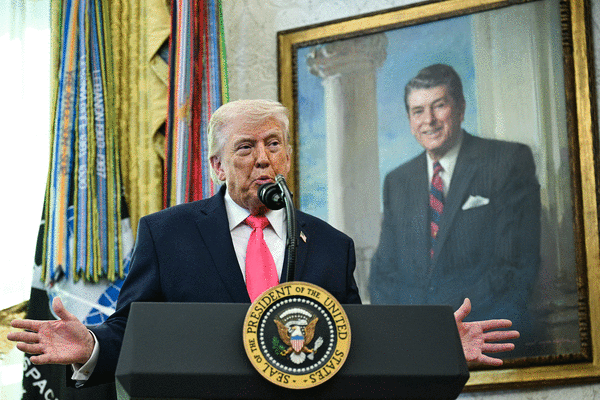
WASHINGTON — President Donald Trump unveiled a nearly $2.2 trillion spending request for fiscal 2027 on Friday that features an enormous defense boost, posing a major challenge to GOP leaders as they seek an election-year spending deal with Democrats.
National security spending would soar to $1.5 trillion in the fiscal year that begins Oct. 1, a roughly 42 percent — or $445 billion — increase from this year’s level, the budget shows. But the administration is counting on Republicans to provide most of that increase, or $350 billion, through a filibuster-proof reconciliation bill, outside of the normal appropriations process.
Nondefense programs, meanwhile, would again be put on the chopping block. Discretionary nondefense programs would face a net cut of $73 billion, or 10%, in the coming fiscal year. And if proposed increases for veterans and Pell Grants were set aside, all other nondefense programs would take a collective hit of $95 billion.
Even so, the budget ax would not fall quite as sharply as the administration had sought last year, when it proposed slashing nondefense programs by about $160 billion, not counting homeland security funding. Congress largely rejected those cuts in its final fiscal 2026 appropriations laws.
All told, spending would amount to nearly $2.18 trillion, a 15.3% increase, after accounting for disaster relief, wildfire suppression and other programs that don’t count against annual spending limits. But the budget document didn’t include all the mandatory spending programs, such as Social Security and Medicare, along with interest on the debt, that would show total federal spending surpassing $7 trillion in the coming year.
The budget “builds on the President’s vision by continuing to constrain non-defense spending and reform the Federal Government,” Office of Management and Budget Director Russ Vought wrote in a letter to Congress accompanying the budget.
“The Budget maintains investments in border security and immigration enforcement while protecting the Nation from threats of terrorism; delivers on the President’s commitment to support law enforcement and ensure they have the tools, technology, and resources necessary to keep themselves and Americans safe; and honors the Nation’s sacred obligation to military veterans,” Vought wrote.
The proposal immediately drew serious pushback from Democrats. Senate Appropriations ranking member Patty Murray, D-Wash., said that Trump’s vision as laid out in the budget is “bleak and unacceptable.”
“President Trump wants to slash medical research to fund costly foreign wars,” Murray said in a statement. “It doesn’t get more backward than that, and the only responsible thing to do with a budget this morally bankrupt is to toss it in the trash.”
The request, while largely a messaging document, will help shape Republican priorities heading into the midterm elections, where they will fight to retain their thin majorities in both chambers. It also marks the official kickoff of the fiscal 2027 appropriations process, which is already starting about two months late.
The president’s request is due by statute on the first Monday in February, though that deadline is seldom honored. And the fiscal 2026 appropriations process isn’t even completed yet, as lawmakers continue to fight over funding for the Department of Homeland Security amid a partisan war over immigration enforcement.
Defense bonanza
Republicans were quick to cheer the proposed defense boost, which Trump had already telegraphed months ago but which gained added attention as the administration launched military strikes against Iran.
The request is “truly historic when it comes to defense spending,” Senate Budget Chairman Lindsey Graham, R-S.C., said in a statement. “It is the most robust increase in defense spending in many years, and it is more than justified by the threats we face throughout the world.”
Trump is expected to seek even more defense funding in a supplemental request for the Iran war that could amount to $200 billion. And much of the defense request appeared aimed at countering the growing threat from China.
Murray said the request would give the Pentagon an amount that it “can’t possibly spend responsibly.”
“Donald Trump might be happy to spend more money on bombs in the Middle East than on families here in America — but I am not,” she said.
And the prospects for another budget reconciliation bill for substantial new defense spending are shaky, though they gained a little strength in recent days with Trump’s newly pledged support for the plan.
But some GOP appropriators and war hawks in both chambers are wary of continuing to provide significant funding through reconciliation, without building those increases into the annual spending levels. The Pentagon is expected to release further details about its spending plans later in April.
Nondefense programs targeted
The budget lays the groundwork for another clash with Democrats over nondefense spending as it seeks significant cuts to discretionary budget authority for a slew of departments key to the party’s priorities.
That includes base discretionary cuts of 52.4% for the EPA, 30.4% for the State Department and international programs, 25.9% for the Labor Department, 19% for the Agriculture Department, 12.7% for the Department of Housing and Urban Development, and 12.2% for the Department of Health and Human Services.
Additionally, the administration wants to cancel $20 billion in funding from the 2021 infrastructure law.
The budget calls for eliminating programs deemed “woke,” “wasteful” or “outdated” by the administration. These include the Minority Business Development Agency, Job Corps, Community Development Block Grant, the Low Income Home Energy Assistance Program and the HOME Investment Partnerships Program.
“It’s not possible for us to take care of daycare, Medicaid, Medicare, all these individual things,” Trump said Wednesday at the White House. “They can do it on a state basis. You can’t do it on a federal. We have to take care of one thing: military protection. We have to guard the country.”
Senate Appropriations Chair Susan Collins, R-Maine, praised the defense boost, but said the nondefense side of the request had “several shortcomings” that Congress had already rejected in fiscal 2026.
“For example, the proposal includes unwarranted funding cuts in biomedical research,” she said. “It would also terminate worthwhile programs like LIHEAP, which helps low-income families and seniors to pay their energy bills during the cold winter and hot summer months, and TRIO, which assists low-income, first-generation students in pursuing higher education.”
With relatively flat nondefense spending since Republicans took back control of the House in the 2022 midterm elections, key programs that are Democratic priorities are starting to feel the pinch.
For example, the Pell Grant program — which provides college aid for millions of lower- and middle-income students — is facing an unprecedented $17 billion gap between available appropriations and projected need. The estimated shortfall means appropriators will either need to find an outside cash boost or cut other nondefense programs or reduce Pell eligibility.
This year’s budget request includes an additional $10.5 billion for federal Pell Grants, up to a total of $33 billion. The funding boost would allow for the discretionary maximum award to remain at $6,335, while also addressing the ongoing funding shortfall, according to the proposal.
The Education Department would be funded at $76.5 billion, a net cut of 2.9% despite the Pell Grant boost. Vought wrote that the budget “continues the Department of Education’s path to elimination, returning control of education back to America’s families.”
A few agencies would see increases under the proposal, including a 13% boost for the Justice Department, an 8.7% increase for the Department of Veterans Affairs and a 6.2% increase for the Transportation Department.
Rosy outlook
The administration also projects a fairly rosy economic outlook for the coming decade, boosting revenue forecasts that could otherwise fall short.
It assumes no recessions, with average annual economic growth projected at 2.97% over the decade. By contrast, the nonpartisan Congressional Budget Office projects only 1.8% annual growth over the same time period.
The White House also projects a 3.9% unemployment rate in 2026, falling to 3.7% in 2027 and maintaining that level throughout the decade. The current unemployment rate for March is 4.3%.
And inflation, as measured by the consumer price index, would be 2.3% this coming year, dropping to 2.2% for the rest of the decade.
As appropriators begin their budget hearings and prepare for markups, neither chamber is likely to abide by Trump’s request. Last year, House Republicans cut nondefense spending by about 6% in their bills, far below Trump’s ask. The House has also prided itself in keeping overall spending flat in final deals and cutting spending in their annual bills, which will complicate writing the fiscal 2027 bills.
Lawmakers are expected to pass a continuing resolution in September to extend current funding until after the election, as is typical during election years.
_____
Aris Folley, Jacob Fulton and Paul M. Krawzak contributed to this report.
_____
©2026 CQ-Roll Call, Inc., All Rights Reserved. Visit cqrollcall.com. Distributed by Tribune Content Agency, LLC.





Comments