Nicolás Maduro fades fast as Venezuela's ruling movement rewrites its future
Published in News & Features
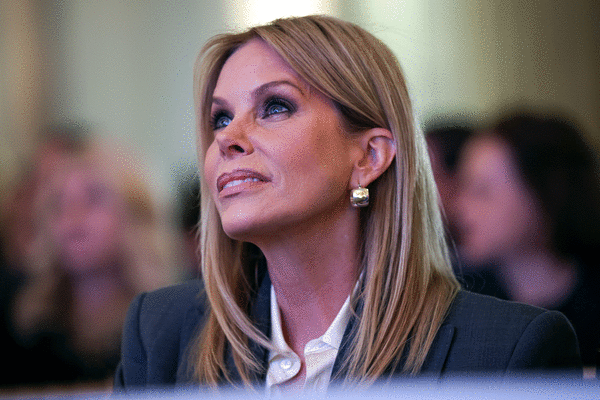
The shift is visible across Venezuela’s capital.
Billboards that once carried Hugo Chávez’s image in the deep red color of the “Bolivarian Revolution” now show something different: Interim President Delcy Rodríguez, framed in light blue, with a new slogan: “Delcy, move forward, you have my trust.”
It is more than a rebranding. It is a signal that chavismo is entering a new phase — and doing so quickly.
“In ninety days, Maduro went from being the ruler in control of the regime that stood up and challenged Trump to becoming an ordinary prisoner who has no weight in Venezuelan politics,” analyst Antonio De La Cruz said.
The speed of that collapse — political and symbolic — has surprised even insiders.
Just three months ago, Nicolás Maduro embodied the Venezuelan state. Today, he is a defendant in a New York courtroom, where he faces charges including narco-terrorism and cocaine trafficking. A federal judge has already refused to dismiss the case.
Outside the courthouse in Manhattan, small groups of supporters have denounced the trial as illegitimate. But inside Venezuela, attention has already shifted.
Power, for now, is elsewhere.
Maduro’s son, congressman Nicolás Maduro Guerra — widely known as Nicolasito — is trying to keep his father’s political relevance alive.
At rallies in Caracas, he has called for unity and framed the prosecution as an attack on Venezuelan sovereignty.
“Venezuela stands firm and upright,” he said, urging citizens to mobilize.
But his message feels anchored in a political moment that is slipping away.
“He is defending a past that others inside chavismo are quietly burying,” De La Cruz said.
At the center of that transition is Rodríguez.
Once one of Maduro’s most loyal defenders, she has steadily transformed into the most powerful figure inside chavismo — a shift years in the making but accelerated dramatically in recent months.
A lawyer by training and the daughter of a prominent leftist intellectual, Rodríguez first rose to prominence as Venezuela’s foreign minister, where she became known for her combative defense of the government on the international stage.
She later consolidated her influence as vice president, overseeing key areas of governance during some of the country’s most turbulent years. Her power expanded further when she was entrusted with managing the oil sector following corruption scandals that brought down senior figures.
Her ascent reached a turning point in January, when she assumed the role of interim president after Maduro and his wife, Cilia Flores, were captured in a pre-dawn U.S. operation in Caracas. From that moment, Rodríguez moved quickly to consolidate control, evolving from a political loyalist into the regime’s central broker — managing economic policy, overseeing strategic industries and negotiating with foreign governments.
“She became the woman of transactions — suitcases, gold, Spain — signing deals with the Trump administration to allow U.S. companies back into the country,” De La Cruz said. “Now she is the operator of the tutelary state set up after January 3.”
Her consolidation of power has coincided with an unexpected shift in tone from Washington.
President Donald Trump has repeatedly singled out Rodríguez for praise in public remarks, describing her as “strong” and “effective” and capable of delivering stability in Venezuela. Administration officials have similarly framed her as a pragmatic counterpart willing to engage on energy, migration and security issues — a sharp contrast with the more confrontational posture associated with Maduro’s rule.
That public endorsement has strengthened Rodríguez’s standing both at home and abroad, reinforcing her image as the figure best positioned to manage Venezuela’s transition while maintaining enough continuity to reassure key power brokers inside the country.
Her messaging reflects that shift.
Speaking during a Holy Week event, Rodríguez avoided ideological rhetoric and instead emphasized recovery and stability.
“Let us imagine a Venezuela free of sanctions,” she said, calling for rebuilding incomes and restoring social programs.
The tone is deliberate. So is the imagery.
The move away from the revolution’s traditional red toward softer colors signals not a rupture, but a recalibration.
According to De La Cruz, the driving force behind Rodríguez’s strategy is not ideology but survival.
“What she is seeking is survival — her own and that of her group,” he said. “She is buying time to continue ruling Venezuela even after the Trump administration comes to an end.”
Stability is the message she is selling, both at home and abroad.
“She is telling the Trump administration: ‘We are the ones who guarantee that nothing happens here, that everything stays calm so that investments come’,” he said.
That promise is already reshaping policy.
Rodríguez has moved to reopen diplomatic channels with Washington even as Maduro stands trial in the United States. At the same time, analysts say her government is showing a willingness to make concessions that would have once been politically unthinkable — including allowing U.S. oversight of surplus oil revenues and accepting contracts governed by U.S. law.
Both, De La Cruz argues, amount to a significant shift away from chavismo’s long-standing emphasis on sovereignty.
“And she’s willing to do whatever it takes to remain in Miraflores,” he said.
Inside Venezuela, the transition is unfolding without a formal break. Chávez remains part of the official narrative, but his presence has faded. Maduro has not been openly repudiated, but he is increasingly absent.
The movement is adapting — quietly, incrementally.
Maduro himself has adopted a different tone. In recent letters posted online, he has called for reconciliation and peace, invoking religious language.
“May Venezuela be a house of reunion,” he wrote.
It is a voice far removed from the combative rhetoric that once defined his rule.
For Rodríguez, the immediate challenge is legitimacy. But rather than rushing toward elections, she appears focused on rebuilding her image.
The billboards. The softer rhetoric. The outreach to Washington. The economic opening.
Each is part of a longer strategy. The result is a movement evolving along two tracks.
On one side, Maduro’s allies — led by his son — are trying to defend his legacy and rally support as he faces trial abroad.
On the other, Rodríguez is reshaping chavismo from within, steering it toward a more pragmatic, transactional model of power — and, potentially, toward her own presidential bid.
There has been no formal rupture. But the direction of change is becoming increasingly clear.
A post-Maduro chavismo is no longer theoretical. It is already taking shape.
©2026 Miami Herald. Visit at miamiherald.com. Distributed by Tribune Content Agency, LLC.



Comments