Minnesota Democrats report being followed, harassed by ICE agents during immigration surge
Published in News & Features
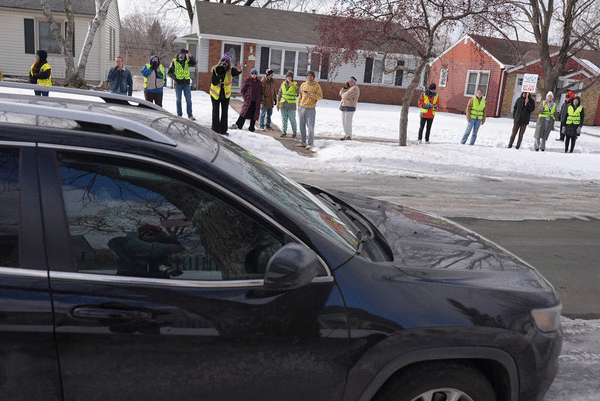
MINNEAPOLIS — State Rep. Brad Tabke had been following what he believed to be immigration agents driving through his southwest suburban district in early January when the SUV suddenly pulled into his neighborhood.
The third-term DFL lawmaker, who had been leading a training for Minnesotans on observing immigration officers during Operation Metro Surge, watched as the vehicle stopped in front of his Shakopee home for a few seconds before pulling away again.
“They made a big show of pointing a camera way out their window so that I could see them taking pictures of my house,” he said.
Records reviewed by the Minnesota Star Tribune show that immigration enforcement agents ran Tabke’s license plate number about 30 minutes before video shows the SUV driving to his home on Jan. 3. The same thing happened again in February. After that initial encounter, Tabke said he saw what appeared to be federal immigration agents outside his home at least a half dozen times, sometimes with binoculars.
Tabke is one of several Democratic lawmakers who said they were targeted or harassed during the Trump administration’s monthslong immigration crackdown in the state. One DFL lawmaker told colleagues that federal agents hurled misogynistic epithets at her, even after she informed them she was an elected official. Another DFL legislator said an agent — with whom she had never interacted — greeted her by first name, while another said agents walked around her home taking photos.
“It was all a way of threatening and being very menacing in a way that perhaps would inhibit us from advocating the way that we had been,” said Sen. Mary Kunesh, DFL-New Brighton.
Federal agents’ behavior toward DFL lawmakers came as President Donald Trump continually attacked Minnesota Democrats and the state’s Somali community, promising “reckoning and retribution” at the height of the surge. Minnesota Attorney General Keith Ellison argued in court that the motivation for the surge was not immigration policy but rather political animosity toward Democrats.
Similar targeting of elected officials happened during the administration’s immigration crackdown in Chicago last year, said Ed Yohnka, a spokesperson for the ACLU of Illinois.
“There was this underlying desire to simply attack people because they didn’t agree with Trump administration policies, whether that was about immigration or other things,” he said.
Democratic lawmakers are now pushing legislation in response to tactics used by federal agents during the crackdown in the state. But Minnesota Republicans have blamed much of the chaos during the ICE surge on Democratic leaders, who pushed back against the federal government.
“What you saw from top leaders in our state and the negative rhetoric that really was inciting either violence or kind of taking the temperature up is how things got to the point that they were here,” said House Speaker Lisa Demuth, R-Cold Spring, who is running for governor.
The U.S. Department of Homeland Security did not respond to requests for comment about interactions with Democratic lawmakers in Minnesota.
The day Tabke said agents first led him to his home, he said he and his wife had left a training for Minnesotans observing federal agents after hearing ICE was in the area. Tabke said the two then observed from their car as agents conducted an operation at a local apartment complex. Agents blocked them in the apartment parking lot and appeared to take down their license plate information, he said.
Tabke said his youngest child was home alone at the time. The whole ordeal frightened him, though he said other observers had much more violent confrontations with immigration officers.
“We shouldn’t have to fear our federal government for working to uphold our Constitution,” Tabke said.
During a Senate hearing in February on a bill to require federal agents to unmask, Sen. Lindsey Port said agents had followed her and parked outside her Burnsville home.
In an interview, Port said that cars driven by what she believed were immigration agents — with missing license plates, tinted windows and drivers in tactical gear and masks — parked in front of her house on three occasions she’s aware of, adding that they walked around and took photos.
“I haven’t broken the law. I haven’t impeded an investigation,” she said in the hearing. “I haven’t even gotten out of my car at an ICE interaction to be on any sort of list for any sort of reason.”
Republicans have pushed back on the DFL proposals, arguing that federal agents were the ones put at risk. Sen. Michael Holmstrom, R-Buffalo, tried to amend Port’s bill to increase penalties for doxing agents. He described Minnesotans who tracked and observed immigration officials during the surge as committing acts of “domestic terrorism.”
“There is an organized insurgency among the people of Minnesota … a small group of Minnesotans have come together to chase, to try to track, to spread information and dox these individuals and these officers – even individuals who were there protesting on the other side of the aisle,” Holmstrom said.
That criticism was echoed by Rep. Bidal Duran Jr., R-Bemidji, who said in a February House committee hearing that “we as legislators took it to the next level when we started attacking cops and started attacking federal agents.”
But Rep. Jessica Hanson, DFL-Burnsville, pushed back on his comment in committee, saying she went to a public park during the surge to walk her dog and encountered dozens of ICE agents, who drew their guns and questioned why she was there.
As she drove away, the group of agents, including in an armored vehicle, left the parking lot driving the same direction. She feared they were following her but soon realized they were headed to a home in her neighborhood, where they surrounded an entire block. She observed from a distance.
Hanson said as she watched, she noticed students arriving home from school were struggling to get to their homes because the roads were blocked. She tried to intervene, telling agents she was a state lawmaker.
Federal agents called Hanson a “slut,” a “bitch” and a vulgar term to refer to women, “after recognizing who I was.”
“How am I to professionally interact with somebody who calls me a slut after I identify myself as a representative?” Hanson said.
Like other DFL colleagues, Kunesh got involved in a rapid response network in her community and patrolled near schools and bus stops on the lookout for immigration agents.
One day, Kunesh said a vehicle circled the area around a school as she was patrolling.
“I was standing in front of the school and he stopped and he rolled down his window and gave me a very menacing look and said, ‘Well, good morning, Mary,’” Kunesh said.
Minnesota Senate Minority Leader Mark Johnson, R-East Grand Forks, declined to comment through a spokesperson.
House DFL Leader Zack Stephenson, of Coon Rapids, said he had heard similar stories from several colleagues.
“So people following ICE appropriately, legally, and ICE leads them directly to their home — that is some unacceptable behavior of intimidation,“ he said. ”What message is that person supposed to take from that other than, ‘We know who you are, and we know where you live?’”
Minnesota Senate Majority Leader Erin Murphy, DFL-St. Paul, said federal agents’ actions were “shameful.”
“Those agents know what they’re doing, and should be held accountable,” Murphy said in a statement.
DFLers have proposed legislation to rein in federal agents, from Port’s bill on masks to allowing Minnesotans to sue ICE if their rights are violated and prohibiting schools and hospitals from allowing federal agents inside without signed judicial warrants.
So far, they haven’t been able to build support among their Republican colleagues, leaving their fate in doubt this session. The House is evenly divided between the two parties, meaning any bill needs bipartisan support to pass. Demuth said she didn’t anticipate any of those proposals passing the House.
While the immigration surge has eased since its fever pitch in January after agents shot and killed Renee Good and Alex Pretti, Tabke said the Trump administration must be held accountable for the Minnesota surge.
“It’s still early, obviously,” Tabke said, “but there are no repercussions so far.”
©2026 The Minnesota Star Tribune. Visit at startribune.com. Distributed by Tribune Content Agency, LLC.



Comments