US set to deploy 2,000 troops from 82nd Airborne to Middle East
Published in News & Features
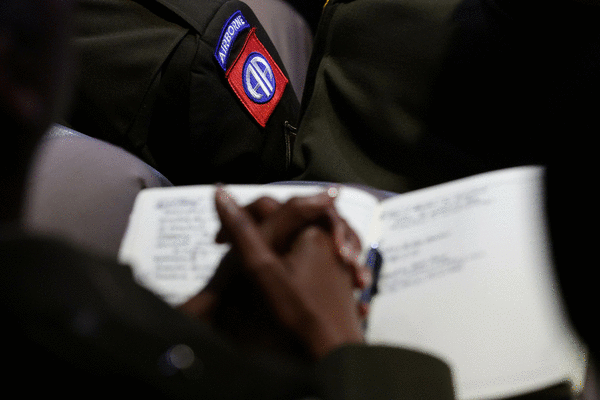
WASHINGTON — The Trump administration has ordered the 82nd Airborne Division to deploy about 2,000 soldiers to the Middle East, a person familiar with the matter said, as the White House weighs options to ease Iran’s chokehold on the Strait of Hormuz.
The verbal orders are for about two battalions plus enabling units, according to the person, who asked not to be identified discussing plans that haven’t been made public. They add to the two Marine Expeditionary Units — with about 5,000 troops — that should start arriving in the region in the coming days.
Administration officials haven’t said what the troops will be used for but they could be tasked with a variety of support roles or serve as the vanguard of a ground attack. Scenarios including seizing Kharg Island, which handles the bulk of Iran’s energy exports, occupying land along Iran’s coast or participating in an operation to seize Iranian nuclear material.
“All announcements regarding troop deployments will come from the Department of War,” White House spokeswoman Anna Kelly said, using the administration’s preferred term for the Defense Department. She said President Donald Trump “has all military options at his disposal.”
The Wall Street Journal reported earlier that the U.S. was deploying a brigade combat team of about 3,000 troops under the 82nd Airborne division. Fox News reported that the commander of the 82nd, Major General Brandon Tegtmeier, has been ordered to deploy along with his command element.
A potential deployment of ground troops in the war against Iran would further escalate the conflict at a time when markets had expected the opposite following Trump’s comments on Monday that he was pursuing talks with Iran to end the war.
Stocks fell and oil prices rose on Tuesday afternoon following the reports, while comments from Trump about possible Iran talks later drove stocks from session lows.
The 82nd, stationed at Fort Bragg, North Carolina, is an elite rapid response force designed and trained to deploy anywhere in the world within 18 hours. Its light infantry troops are trained to parachute down for raids and secure high-value targets such as airfields.
Trump hasn’t ruled out seizing the Iranian oil export hub of Kharg Island to pressure Tehran over the vital Strait of Hormuz. The U.S. had already dispatched two Marine Expeditionary Units, as more planes and ships continue to arrive in the region.
While the 82nd Airborne would likely deploy via parachute jump, Marines from the expeditionary units would likely arrive on helicopters, amphibious landing craft and small boats.
The moves come as pressure grows on the U.S. to take action to reopen the Strait of Hormuz, a vital waterway for global oil and gas flows that has been effectively shut since the war began on Feb. 28, causing energy prices to soar.
It also comes just a day after Trump said the U.S. was engaged in talks with Iran to end the war — negotiations that Tehran has denied. On Tuesday, Trump said the U.S. had effectively defeated Iran militarily, and the two sides were now talking about ending the conflict.
“We’re in negotiations right now,” Trump told reporters at the White House, noting that special envoys Steve Witkoff and Jared Kushner as well as Secretary of State Marco Rubio and Vice President JD Vance are all involved. “I think we’re going to end it, I can’t tell you for sure.”
“Washington may be hoping that the signal sent by their deployment will bring Tehran to the table,” Bloomberg Economics analysts Becca Wasser, Jennifer Welch and Adam Farrar wrote in a research note on Tuesday. “If that gambit fails, and once the 82nd Airborne troops arrive in theater, there are several potential mission sets for them. All carry a high degree of military — and by extension political — risk.”
At the same time, Israeli Defense Minister Israel Katz has said their contributions to the military campaign would continue “at full intensity.”
Separately, several countries in the Gulf are weighing whether to respond with military force to ongoing Iranian retaliation against their energy infrastructure, according to several people with knowledge of the situation, who requested anonymity in order to speak freely.
Gulf countries would only join the war if Tehran followed through on threats to attack crucial Gulf power and water infrastructure — a high threshold, the people added.
_____
(With assistance from Courtney Subramanian.)
_____
©2026 Bloomberg L.P. Visit bloomberg.com. Distributed by Tribune Content Agency, LLC.






Comments