Miami-Dade police, Florida Highway Patrol and others contracted with tech startup funded by Epstein
Published in News & Features
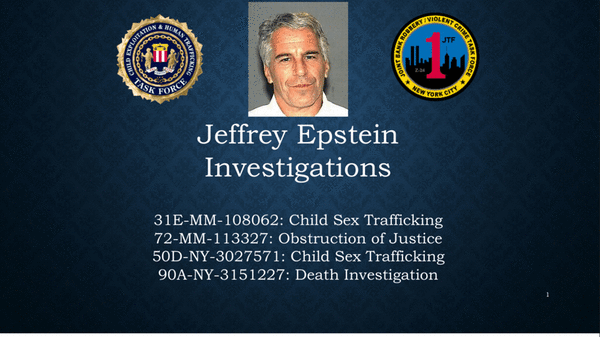
MIAMI — Roughly seven years after Jeffrey Epstein pleaded guilty to two prostitution charges in Palm Beach County in 2008, he secretly invested $1 million in an Israeli security technology startup that had signed deals with multiple law enforcement agencies in Florida, including the Miami-Dade Police Department.
The Florida Highway Patrol, the Florida Fish and Wildlife Conservation Commission and North Miami Beach Police also inked contracts with Carbyne, which developed an app that allows 911 callers to share videos with 911 dispatchers, enabling first responders to get a preliminary assessment of the scene.
Miami-Dade County spent nearly $2 million on a three-year contract with Carbyne in September 2021 for the Miami-Dade Police Department, now Sheriff’s Office, to test the system.
The agency told the Miami Herald it didn’t have any active contracts with Carbyne. The county mayor’s office told the Herald that the contract had been awarded through the standard procurement process, which does not include a review of a company’s investors.
North Miami Beach’s police department uses an application similar to the one contracted by the Miami-Dade Sheriff’s Office, the company said in a March 2024 release announcing the deal.
Commander Nichole Camacho of the city’s police department called Carbyne’s system a “game changer” that would ensure officers had the “right information to respond quickly,” the release said.
The agency told the Herald that its contract was worth around $600,000 and was in place until 2029.
Florida Highway Patrol undertook a project, dubbed the “Desk Trooper” program, in late 2024 in which state troopers used Carbyne’s technology to remotely respond to minor road accidents on the Central Florida Expressway in greater Orlando.
The expressway authority — a state agency — paid roughly $900,000 as per the contract, which will expire in October, according to a copy of the contract the Herald obtained through a public records request.
The Fish and Wildlife Commission declined to answer the Herald’s questions about its contract with Carbyne.
The Herald’s findings about Epstein’s involvement in Carbyne is based on the millions of pages of Epstein records recently released by the U.S. Justice Department.
The Arizona-based security tech giant, Axon, acquired Carbyne for $625 million last year. Axon is best known for making police body cameras and Tasers. It is unclear whether Axon knew that Epstein had been an early investor.
Axon’s filings to the Securities and Exchange Commission and earnings calls from the time around the acquisition do not mention the disgraced financier. Axon did not respond to the Herald’s multiple requests for comment.
Connections with ex-Israeli prime minister
Epstein’s investment in Carbyne was brokered by former Israel prime minister Ehud Barak, with whom he shared a years-long relationship.
Carbyne, initially named Reporty Homeland Security, was founded by a group of Israelis with backgrounds in the country’s military and intelligence services. The privately held company launched in the spring of 2015 in Israel. Today it is headquartered in New York with offices in Tel Aviv.
Barak was an early investor in Carbyne and board chairman but the released records show that at least $1 million of his funds came from Epstein’s Southern Trust Company. Epstein first started conversations with Barak about a possible investment in December 2014, according to the records, roughly five months before the startup’s launch.
“I assume that by Monday evening we will be ripe for decision on th= investment. Most probably a positive one,” wrote Barak in a Dec. 18, 2014, email to Epstein. “PI [sic.] make the proper preparations.”
Epstein sent the funds to one of Barak’s holding companies in March 2015.
Nicole Junkermann invested another $500,000, the released records show. Junkermann, a German countess and entrepreneur, had a decades-long relationship with Epstein and according to the released documents, shared sexually explicit messages with him.
The company was valued at $4.5 million at the time of the investments by Epstein and Junkermann, the records show. The released records also include some of the company’s financials. None list Epstein as an investor.
Keep the investment quiet
An email about the investment from Darren Indyke, Epstein’s personal attorney, indicates that Epstein did not want his involvement made public.
“I thought we did not want your name associated with this investment,” wrote Indyke in March 14, 2019, missive to the financier about whether they should reveal his identity to Carbyne.
Barak disputed the characterization of Epstein’s investment as “secret” through a statement by his attorney Bruce Goodman.
The attorney said in a March 11 email to the Herald that Epstein’s Southern Trust was one among several limited partners, had no role in Carbyne’s “management or decision making” and exercised its right to remain confidential.
“All of Mr. Barak’s business activities, including those related to Reporty/Carbyne, were conducted with the advice of legal counsel, in compliance with all laws and regulations,” Goodman wrote in the email.
Epstein’s correspondences show he received regular updates about the company until March 2019 — just months before federal agents in New York arrested him on July 6, 2019, on two counts of sex-trafficking of minors. He was found dead in his cell at the federal detention center in Manhattan on Aug. 10, 2019, a month later. The medical examiner ruled that his death was a suicide by hanging.
Barak stepped down from Carbyne’s board in April 2020. The company did not specify a reason.
Carbyne did not respond to the Herald’s queries about whether senior company officials knew that Epstein had been an investor.
©2026 Miami Herald. Visit at miamiherald.com. Distributed by Tribune Content Agency, LLC.





Comments