Maryland enters national debate with ICE mask ban bill testing state's authority
Published in News & Features
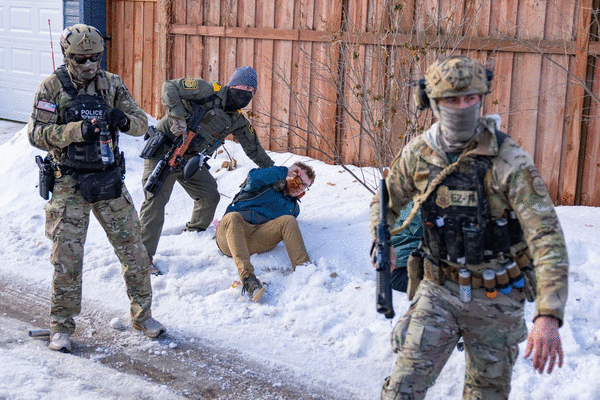
It is not coincidental that a bill restricting U.S. Immigration and Customs Enforcement officers’ face coverings was designated as “Senate Bill 1,” the first major piece of legislation of a new General Assembly session.
Maryland Democrats assigned it that number to illustrate its importance to a party eager to demonstrate its opposition to federal immigration officers’ tactics — notably the use of masks hiding agents’ identities when making immigration arrests.
In emphasizing the bill, state Democrats entered a national fray over whether ICE agents have exceeded their authority as they round up people suspected of being in the country illegally.
The legislation, if approved during the 90-day session that began Wednesday, will provide a test of the state’s authority over federal agents’ activities in Maryland. The bill is backed by leading House and Senate Democrats, but Republicans — and groups representing state sheriffs and police chiefs — expressed concerns about its scope in interviews with The Baltimore Sun.
The Senate Judicial Proceedings Committee is scheduled to hold a hearing Thursday on the bill, which doesn’t mention ICE by name but would block law enforcement officers from wearing tactical masks or gaiters while on duty in the state. The measure makes an exception for officers working undercover. It’s one of 9 bills to be considered in the same committee on the same day. Next week, the judicial committee will hear roughly 30 bills in total, including Senate Bill 245, which Maryland Democratic leaders have largely favored, to bar agreements in which local enforcement officers partner with ICE to enforce federal immigration law. A measure intended to address the use of artificial intelligence and deepfakes “in order to cause physical injury, serious emotional distress, or economic damages” will also be considered, an issue that Maryland lawmakers took up after the federal government tried to discourage states from regulating AI.
The bill comes during a period in which stepped-up ICE enforcement tactics have sparked protests and renewed scrutiny of agent practices.
On Jan. 7, an ICE agent fatally shot Minnesota resident Renée Nicole Good in her vehicle during a confrontation that Department of Homeland Security Secretary Kristi Noem blamed on “domestic terrorism.” National Democrats say the shooting was reckless and unnecessary.
The visuals of ICE officers concealed behind face coverings and tactical equipment can be jarring, many Democrats said during the first week of the session. It is reminiscent of “Star Wars,” said state Senate President Bill Ferguson, a co-sponsor of the bill.
“Anonymous law enforcement, anonymous violence, has an impact and is intentional,” Ferguson said in an interview. “It’s used to create fear, and it is used intentionally to demonstrate power in a way that is not what appropriate law enforcement looks like.”
Republican critics said that the bill amounts to “virtue signaling” and that prohibiting masks could subject officers to citizen violence, threats or doxing.
“I think common sense goes against the ability of a state to limit or regulate law enforcement protocols of the federal government,” House Minority Leader Jason Buckel said in an interview. “My God, the worst thing that could possibly happen is a standoff not about the underlying mission but about what you’re wearing on your face.”
California last year approved the “No Secret Police Act” barring officers’ mask use on the job. The Justice Department, citing the Constitution’s Supremacy Clause, won a court stay of the act after arguing that states lack authority over federal officers’ conduct.
In the interview, Ferguson countered with another constitutional argument. “How law enforcement is conducted within the jurisdiction of a state is, from my perspective, a power reserved to the states through the 10th Amendment,” he said.
The amendment states, in effect, that powers not delegated to the federal government by the Constitution are reserved for the states unless specifically prohibited.
The Maryland Chiefs of Police Association and Maryland Sheriffs Association are studying the bill and haven’t yet announced their position, said Darren Popkin, a former Montgomery County sheriff who chairs a legislative committee for both organizations.
But Popkin said the groups worry about penalties in the bill that could affect — even inadvertently — Maryland officers. The bill calls for a maximum penalty of two years imprisonment and a $2,000 fine for violations.
“The punitive measures are some of the things we’re concerned about,” he said.
_____
©2026 Baltimore Sun. Visit baltimoresun.com. Distributed by Tribune Content Agency, LLC.






Comments